





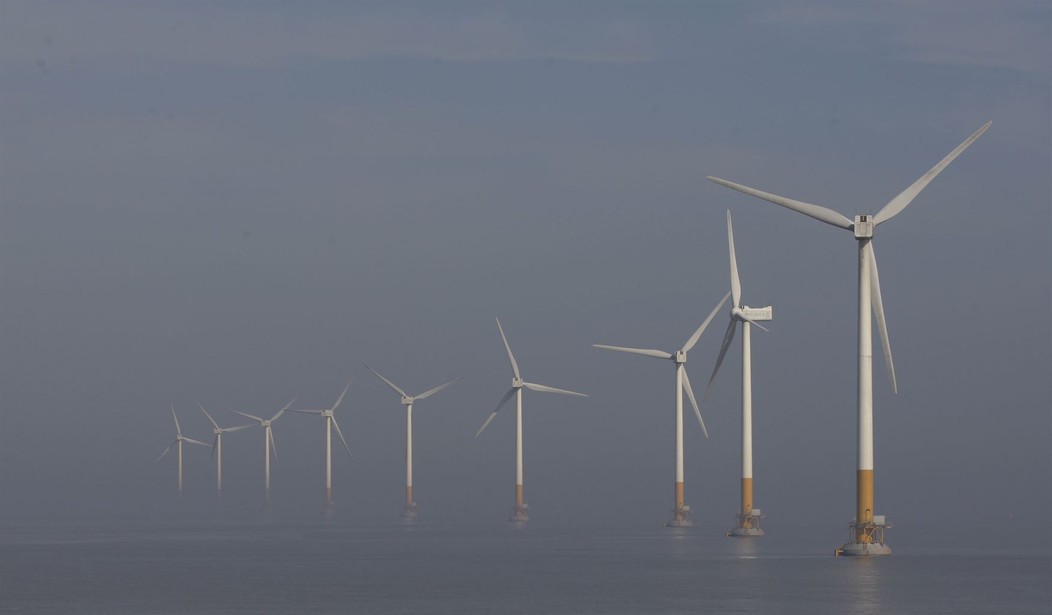
California Attorney General Rob Bonta and California Energy Commission Chair David Hochschild are preparing to sue the Trump administration because the Department of the Interior reached a deal to end an offshore wind project off the state's central coast.
California calls the argument unlawful, while many Americans will call it overdue. From Newsmax:
California has made a major commitment to offshore wind because of its potential to generate vast amounts of clean electricity from strong, consistent winds off its coast. Its strategy calls for the state to develop 25 gigawatts of offshore wind energy by 2045, enough to power roughly 25 million homes and provide about 13% of the state’s electricity supply.
These energy and climate goals are now in jeopardy, and that's why they will fight vigorously, said California Energy Commission Chair David Hochschild.
He called the administration's strategy of buying back offshore wind leases “a strategic mistake of colossal proportions" that is especially stunning at a time when fossil fuel prices have been spiking due to the Iran war.
“Countries that thrive around the world are those that lean into innovation, into the energy sources of the future,” he said in an interview on Tuesday. “And so to turn away from this, and turn back the clock, and really engage in what I consider to be a war on innovation, is really ill-considered. And I think it’s a decision that’s not just bad for California, it’s bad for the nation.”
The fight centers on Golden State Wind LLC and Lease No. OCS-P 0564. The Bureau of Ocean Energy Management says the Department of the Interior will cancel and rescind the lease once Golden State Wind shows it has made the required investments in U.S. oil and gas development. From the California Energy Commission:
In the Notice of Intent to Sue sent to DOI and GSW today, California alleges that DOI’s buyout deal with GSW violates the Outer Continental Shelf Lands Act (OCSLA), which is supposed to ensure that California gets a say in the offshore wind leasing program and prevent corrupt backroom deals. The Notice of Intent to Sue provides a 60-day window for DOI and GSW to cure the OCSLA violations before California files suit to put a stop to this unlawful buyout.
“At a time when the country needs more reliable and sustainable power supply, the Trump Administration is busy using taxpayer money to strike backroom buyouts that make clean-energy projects disappear. California won’t stand idly by as the Trump Administration illegally strikes deals to kill offshore wind projects and replace them with more windfalls for his fossil fuel friends; we’re putting the Administration on notice that we intend to sue,” said Attorney General Bonta. “California has already made substantial investments in clean wind energy that have advanced California’s clean energy goals, created high-quality jobs, and bolstered our economy. My office will continue to fight back aggressively against the Trump Administration’s illegal attacks on wind energy projects.”
“California strongly condemns yet another reckless Trump Administration misuse of taxpayer dollars that undermines clean energy growth and U.S. energy security,” said California Energy Commission Chair David Hochschild. “California will continue to lead the way toward a cleaner, more reliable grid powered by domestic resources. Offshore wind remains an essential component of that work.”
In other words, the administration is moving money away from an uncertain offshore wind future and toward energy sources America can use now.
California's leaders are furious because offshore wind has become more than an energy policy; it's an article of faith. The state wants up to 25,000 megawatts of offshore wind energy by 2045, and officials say more than $100 million in public investment is tied to the industry. Once a project gets wrapped in a climate language, the left treats retreat as betrayal.
Interior Secretary Doug Burgum has moved in the opposite direction. Last week, Interior announced a $765 million agreement with Invenergy to terminate four offshore wind leases in the New York Bight, off California's central coast, and in the Gulf of Maine.
The company will redirect the money toward natural gas plants in Indiana, Wisconsin, Iowa, Kansas, and Missouri, plus geothermal projects in the West.
California sees sabotage, while the Trump administration sees sanity. Offshore wind asks people to accept high costs, huge industrial structures as sea, long transmission challenges, wildlife questions, and a grid that still needs reliable power when the wind drops.
The left continues to believe that any doubt is a sin.
Wildlife questions deserve more than a shrug. The U.S. Fish and Wildlife Service says studies have documented wind energy facilities killing birds and bats, with rates varying by facility and region.
Offshore wind adds another layer because seabirds face collision risks and habitat displacement from infrastructure placed in their flight and feeding areas.
Marine life raises its own concerns. NOAA Fisheries conducts research to fill gaps in understanding how offshore wind affects fish, protected species, habitats, fisheries, and fishing communities.
NOAA also studies ocean noise because many marine animals depend on sound to communicate, feed, navigate, and survive. A serious energy policy would admit the gaps before pouring concrete and steel into the ocean.
None of that means every offshore wind project is doomed or every environmental worry proves fatal. It does mean California's lawsuit looks less like stewardship and more like compulsion. The state wants green energy kept alive through courts, subsidies, mandates, and political pressure, even when a private leaseholder and the federal government agree to walk away.
President Donald Trump paused new offshore wind leasing on his first day back in office, using authority under the Outer Continental Shelf Lands Act. He ordered a review of wind leasing and permitting practices tied to costs, environmental effects, energy reliability, and other public concerns.
Voters chose an administration that promised to change course; California now wants litigation to drag the ship back.
Offshore wind has always sounded cleaner in campaign speeches than it looks in real life. Turbines don't rise from the sea without cost; they require vessels, ports, cables, maintenance, subsidies, and legal protection.
They also need the public to believe questions about birds, whales, fish, noise, and reliability are distractions rather than duties.
California is suing because the Trump administration treated offshore wind as a choice instead of a commandment.
Good.
America needs energy policy rooted in cost, reliability, national interest, trust, and honest environmental review. Green branding doesn't make a project wise, while a lawsuit doesn't make it necessary.
PJM is running a major 60% off sale for readers who want conservative journalism that still asks hard questions. Use promo code FIGHT at checkout and subscribe here.
Join the Conversation
VIP members get the ability to comment on articles.