


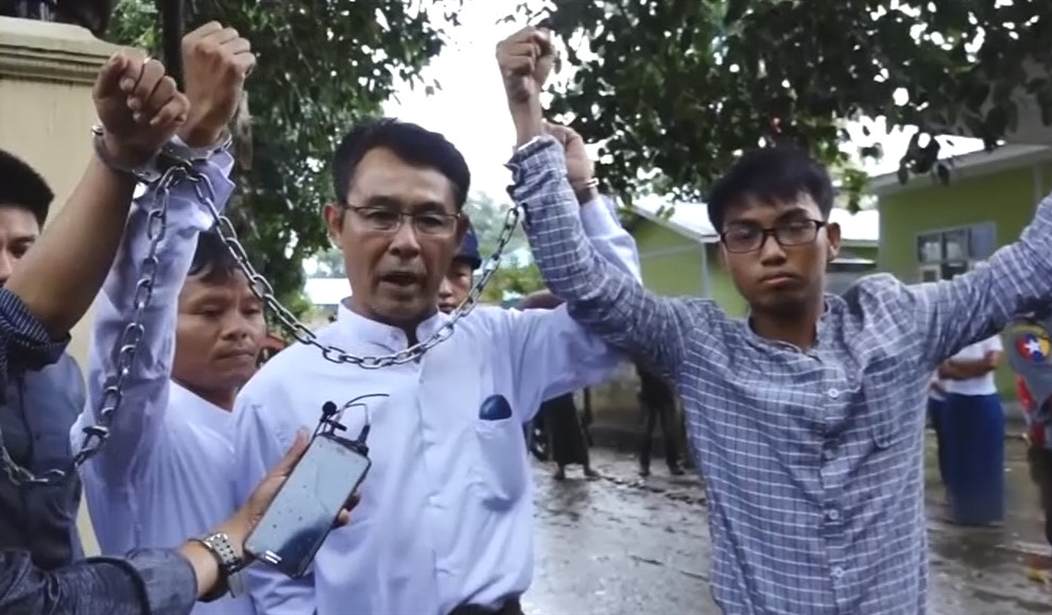
President Min Aung Hlaing now wears a civilian title, but Burma's war still carries the old military smell: fear, smoke, shattered villages, and power aimed at families who can't shoot back. His army seized power in the February 2021 coup, crushed peaceful protests, and helped push Burma into civil war.
Please note: I'm deliberately using Burma instead of Myanmar. The name change came from the military regime, not from a free national vote, and the United States government still uses Burma as its primary name in foreign policy, sometimes adding Myanmar in parentheses for clarity.
As the AP reports, in April 2026, Min Aung Hlaing became president after a military-shaped election process that kept the army in charge while pretending to restore normal politics.
Myanmar’s parliament on Friday elected Min Aung Hlaing, a general who ousted Aung San Suu Kyi’s civilian government in 2021 and kept an iron grip on power for the past five years, as the country’s new president.
The move marks a nominal return to an elected government but is widely considered as an effort to keep the army in power after an election organized by the military that opponents and independent observers deemed neither free nor fair, and as civil war rages.
Transitioning to an elected government is also seen as a way to improve frosty relations with some Southeast Asian neighbors following the military takeover. China and Russia have supported the military administration, while Western powers imposed sanctions.
The junta no longer controls Burma the way it once did. The Arakan Army controls most of Rakhine State. People's Defense Forces tied to the National Unity Government operate in central regions once considered safer for the regime. Armed groups in Shan, Karen, Chin, Kachin, and other areas keep stretching the military thin. A regime losing roads, towns, and loyalty now rules from the sky.
Human Rights Watch highlights the danger everyday Burmese people face.
Since the February 2021 military coup in Myanmar, the junta has driven the country further into a human rights and humanitarian catastrophe. Repression and violence have spiraled as the junta seeks to entrench its rule. Sham elections held in December 2025 and January 2026 were a blatant attempt to manufacture legitimacy for the military-controlled state and derail restoration of civilian democratic rule. The junta has responded to growing armed resistance with increased airstrikes, including unlawful attacks on civilians and civilian infrastructure, enabled by arms and financing from China and Russia. Millions have been displaced internally and across borders. The military’s war crimes and crimes against humanity have been fueled by decades of impunity.
So the junta bombs, fighter jets, drones, and aircraft strike schools, hospitals, camps, towns, and villages in resistance-held areas. In December 2025, a military airstrike destroyed Mrauk-U General Hospital in Rakhine State, killing 34 patients and medical staff and injuring about 80 more. Nearly 93,000 people have died in the civil war, and over 3.6 million have been displaced.
Did You Know: Here's a question for you: were you aware of a civil war in Burma? The only reason I knew about it was my curiosity, and what I found is disturbing.
The National Unity Government claims legitimacy against the junta. Ethnic armed organizations bring older struggles for autonomy into the wider war against military rule. Burma also carries the wound of the 2017 army campaign that drove about 740,000 Rohingya into Bangladesh.
Yet the current picture remains clear: Min Aung Hlaing's regime keeps losing the moral and political arguments and too much of the map.
The political costume doesn't hide the weakness underneath. Min Aung Hlaing resigned as commander-in-chief before becoming president because Burma's constitution bars the president from holding the top military post.
Gen. Ye Win Oo, a loyalist from his inner circle, took over as commander-in-chief. Elections held in December 2025 and January 2026 excluded major opposition forces, blocked real competition, and gave the military-backed Union Solidarity and Development Party the result the regime needed.
Burma now shows a hard lesson about tyrants under pressure. When they can't persuade, they jail; when they can't govern, they burn; and when soldiers lose the road, planes head towards the village. A confident government doesn't need to bomb hospitals.
The people of Burma deserve attention before the next massacre, not sympathy afterward. The Burmese army still kills from the air, but every bomb tells the same story: Min Aung Hlaing's regime has jets, prisons, titles, and ceremonies.
Doesn't this remind you of the time President Joe Biden threatened U.S. citizens with his jets?
And yet, across too much of Burma, Hlaing no longer has control.
Ready for more straight talk that skips the spin and hits the real issues? Join PJ Media VIP today and get 60% off with promo code FIGHT. Click here to lock in your savings now.




Join the conversation as a VIP Member