


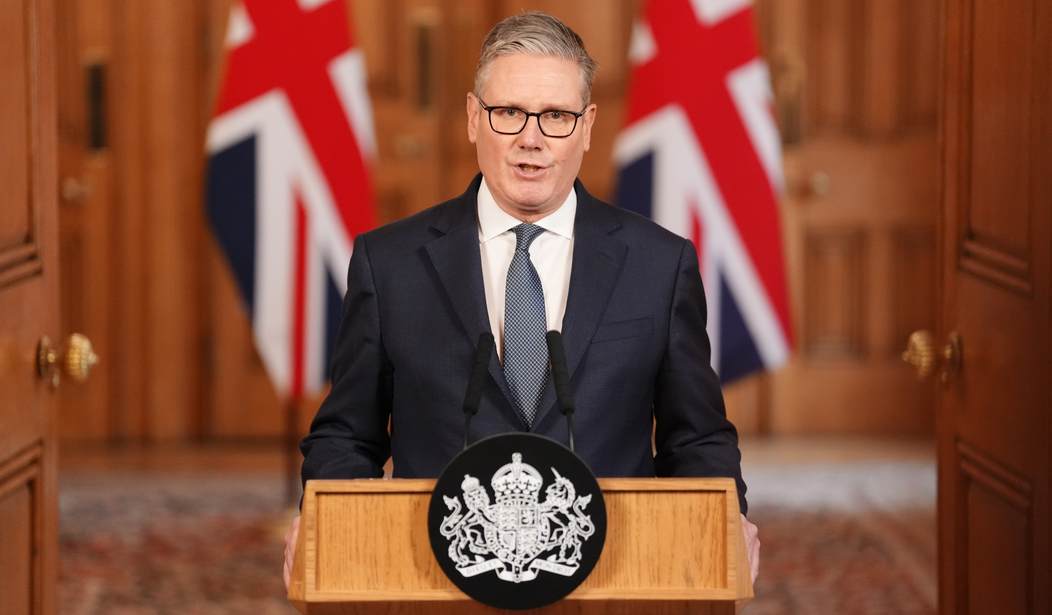
The prime minister of the United Kingdom has a problem large enough to be seen from across the Atlantic. The Labour Party took power in July 2024 with a considerable majority, a battered Conservative Party in ruins, and Prime Minister Keir Starmer promising steady governance.
Flash forward two years, and voters across England, Scotland, and Wales used the May 7-8 elections to hand him a public beating. Labour heavily lost in English council races, fell hard in Wales, failed to gain real ground in Scotland, and watched Nigel Farage's Reform UK turn voter anger into seats, councils, and momentum.
Reuters accurately summarized how things fell apart.
British Prime Minister Keir Starmer vowed on Friday to stay in office to "deliver change" after his Labour Party suffered heavy losses in English local elections and parliamentary votes in Scotland and Wales, deepening doubts over his ability to govern.
Just under two years after winning a landslide national election, Starmer saw voters punish his Labour government, with support evaporating even in its traditional strongholds in London, former industrial regions in central and northern England, and in Wales.
The main beneficiary was the populist Reform UK party of Brexit campaigner Nigel Farage, which gained more than 1,000 council seats in England, and will likely form the main opposition in Scotland and Wales to the pro-independence Scottish National Party and Plaid Cymru.
Early results underscored the fracturing of Britain's traditional two-party system, with the once-dominant Labour and Conservative parties losing votes not only to Reform, but to the left-wing Green Party at the other end of the political spectrum, and to nationalists in Scotland and Wales.
Starmer said he accepted responsibility and would keep trying to “deliver change.”
Translation: Please stop staring at the trapdoor under my shoes.
The AP's Jill Lawless caught Starmer in the act of taking responsibility.
Voters have grown impatient for economic growth and dramatic change after 14 years of Conservative government, and many Labour lawmakers have become despairing at the government’s failure to deliver.
Starmer said he took responsibility for the “very tough” results but would not quit.
“The voters have sent a message about the pace of change, how they want their lives improved,” he said. “I was elected to meet those challenges, and I’m not going to walk away from those challenges and plunge the country into chaos.”
Starmer still has a large House of Commons majority. Local elections can't evict him from Downing Street, but they can make Labour Party MPs count their own survival odds like gamblers down to their last chips.
Reform UK leader Nigel Farage walked away seeming like the man who found the keys to a political vehicle everybody else insisted had no engine. Reform won over 1,000 council seats in England and took control of councils in places including Havering, Sunderland, Suffolk, Essex, and Newcastle-under-Lyme. Ben Quinn, writing at The Guardian, caught up with Farage, who could never be accused of playing down a situation.
“It’s a big, big day, not just for our party but for a complete reshaping of British politics in every way,” Farage said as he appeared on Friday outside Havering town hall, in a borough on the eastern border of Greater London where many voters identify more closely with neighbouring Essex.
Farage said the party was “two-thirds” of the way to where it wanted to be for the general election when it came to planning and fundraising. The door was now closed to Tory defectors, he said, but “the time is now” for conversations with “patriotic old Labour” MPs.
Labour didn't just lose polite suburban grumbling; it lost ground in old working-class areas where party loyalty once passed through families like a surname.
The damage reached old Labour ground: Wigan and Tameside slipped away from Labour control, while Reform drove into the north and Midlands with blunt messages on immigration, the cost of living, public services, and political contempt.
In Wales, Labour suffered a historic humiliation as Plaid Cymru finished first and Reform surged into second. Scotland gave Starmer no rescue boat; the Scottish National Party stayed dominant, and Labour failed to look like a government gaining strength.
Starmer's trouble now sits inside his party; Labour MPs can tolerate pain when polls look recoverable yet tolerate far less when their own seats begin looking like sandcastles at high tide.
Jonathan Brash, Labour MP for Hartlepool, called for Starmer to set a timetable for leaving. John McDonnell, Labour MP for Hayes and Harlington and former shadow chancellor, also urged an orderly transition.
David Lammy, the foreign secretary, and Liz Kendall, the work and pensions secretary, publicly backed Starmer.
Public loyalty in politics often sounds strongest right before private panic starts chewing through the furniture.
A formal no-confidence move may not come right away. Labour still holds a large Commons majority, and parties often fear civil war more than bad polling. Yet Starmer can't wish away his problem with another reset speech; he won power by promising competence after Conservative exhaustion.
Now voters see high taxes, weak borders, rising frustration, and a prime minister who often sounds like a hospital administrator explaining why the waiting room ran out of chairs.
The wider lesson reaches beyond Britain. Left-wing governments across the West keep discovering voters still notice results. They notice border strain, expensive energy, public disorder, weak service, and leaders who lecture before they listen. Starmer now joins a familiar procession of leftist leaders who seemed safe until ordinary voters found the lever and pulled it.
Farage thinks Starmer will be gone by summer. Maybe Farage is gloating; perhaps Labour MPs decide fear of Reform hurts more than loyalty to Starmer. For now, Britain's prime minister remains in office, but his authority took a direct hit.
The next no-confidence vote may already be quietly forming in Labour offices, where members look at maps, count seats, and wonder whether Starmer has become the anchor they can't afford to keep.
The political left keeps finding out that voters still have veto power, and Keir Starmer just got a painful reminder in Britain. For more sharp, plain-spoken analysis of political crack-ups at home and abroad, become a PJ Media VIP member today and use promo code FIGHT for 60% off your subscription.





Join the conversation as a VIP Member