


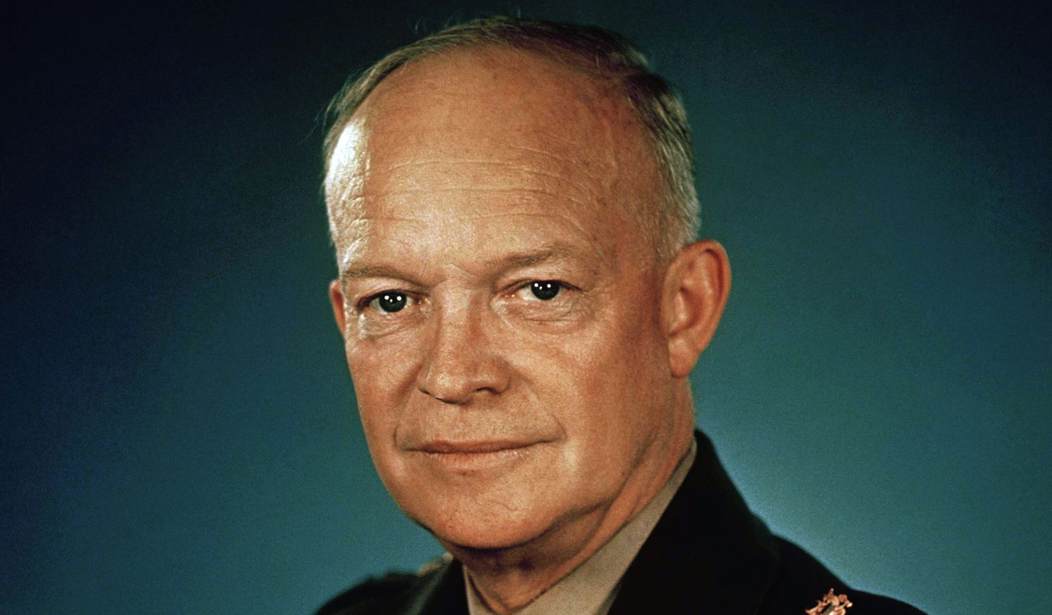
Gen. Dwight D. Eisenhower never reduced victory in Europe to luck; he spoke of logistics, air power, leadership, and artillery. He knew what infantrymen knew in their bones: If American guns answered first and fast, they lived.
Although counter-battery fire at scale didn't begin in 1944, its roots lay in the years between wars at Fort Sill, Okla. The U.S. Army Field Artillery School became a laboratory for men who had watched shells hit harmlessly in France during World War I. They remembered mud, wasted ammunition, and guns firing at nothing.
Major General Lesley J. McNair, a World War I veteran and later the Chief of Staff of Army Ground Forces, drove reform, believing that artillery had to become scientific; guesswork belonged to amateurs. McNair insisted on disciplined survey methods, accurate maps, and centralized fire control. His work reshaped doctrine before most Americans sensed the coming of World War II.
After two decades of a variety of positions, mainly revolving around organization and teaching, McNair was appointed commandant of the Command and General Staff College at Fort Leavenworth in March 1939, half a year before World War II broke out. The Army Chief of Staff, General Malin Craig, and his deputy, McNair’s old friend Brigadier General George C. Marshall, both believed that the college’s teaching methods needed an urgent overhaul in light of the likely coming war. They felt the curriculum was geared too much toward the Regular Army, the relatively small standing Army of the United States, and could not accommodate the rapid expansion and training, nor the maneuver-heavy offensive operations that imminent conflict would entail.
At Fort Sill, officers refined sound-ranging techniques; microphones placed miles apart recorded the boom of enemy guns. Technicians measured the split-second difference in arrival times and plotted intersecting arcs on maps.
Flash-spotting teams scanned the horizon at night for muzzle flashes.
Not so high above, Piper L-4 "Grasshopper" aircraft circled, radioing coordinates: flying at 85 mph and at low altitudes, they were irresistible as targets.
Part of the reason American artillery was so effective was good forward observation. During World War I, fire was adjusted by individual batteries. Battery commanders spotted the fall of their rounds, usually from a crude tower near the guns. In World War II, both German and American artillery fire direction was normally done at the battalion level. A fire direction center typically controlled at least a dozen guns, so better target acquisition and observation of the fall of the rounds than the World War I practice was needed. In the fast-paced fighting of World War II, observers needed to be near or with the troops they supported and to have rapid communication with the fire direction center. When the troops were on the move, landline telephones were useless. Even in static situations, the telephones, with their vulnerable lines, had serious limitations near the front lines. Radio was a possible solution, but early AM radios were fickle and often unreliable. Major, later General, Anthony C. McAuliffe studied the FM radios that the Connecticut State Police had begun using and convinced the Army to develop FM vehicle radios. These provided a strong, clear signal for about forty miles. Germany developed a family of high-frequency vehicle radios for military use, but their radios were not nearly as effective as the American versions. By the last year of the war in Europe, Germany was deploying its own family of FM radios.
Each separate source offered nuggets; combined, they formed a grid.
Brig. Gen. Leo A. Baxter, serving as Assistant Commandant at the Field Artillery School, expanded those programs in the late 1930s, pushing for tighter integration between detection units and firing batteries. Training became relentless: students learned to calculate, plot, and fire with mechanical speed.
Capt. Abbott H. Burns added another breakthrough. He developed refined firing tables and graphical models that allowed dispersed batteries to fire so that shells arrived precisely at the same second. The method became known as Time-on-Target; instead of warning the enemy with scattered, zeroing impacts, American guns struck in a single, crushing wave.
German artillery doctrine relied on speed of movement: Batteries would fire three to five rounds and relocate within 15 to 20 minutes. The approach worked well against opponents who needed time to calculate a response. German crews knew a response would eventually arrive, but they knew it would happen too late to hurt them.
American counter-battery teams reduced the response time window to under 10 minutes, often much less. Detection units triangulated sound and flash; controllers plotted vectors using accurate maps; orders flowed; guns elevated; shells flew.
The results resembled a mosquito landing for a quick bite. The sting registered first, and the slap followed immediately, leaving a dead bug.
During the Normandy campaign, Gen. Omar Bradley, commanding First U.S. Army, unleashed coordinated barrages that stunned German defenders. Hundreds of guns fired Time-on-Target missions that collapsed defensive lines before the infantry advanced. German Field
Gen. George S. Patton, commanding Third Army, depended on rapid counter-battery fire during his sweeping advances across France. His armored columns crossed rivers and entered towns under protective barrages that silenced German guns before they could regroup.
Artillerymen didn't see glory up close; their job was far from glamorous. They worked with maps, slide rules, and radio sets, while trusting mathematics. When a German battery opened fire, American observers didn't panic: They listened, watched, plotted, then answered.
It was a slightly different story on the other side of the world: The Pacific theater demanded answers. On Okinawa, Lt. General Simon Bolivar Buckner Jr., commanding the Tenth Army, faced Japanese forces under Lt. Gen. Mitsuru Ushijima. Japanese gunners operated from caves carved into ridgelines: crews rolled guns out to fire, then dragged them back, hiding them behind rock walls.
American shells struck stone.
Everything about the terrain on Okinawa favored the defending army. The topography of ridgelines and escarpments turned the field of battle into a series of small, vicious firefights, allowing the Japanese to observe their enemy in full due to the lack of dense vegetation. Interlocking fields of fire from the caves and concrete Okinawan tombs all over the ridgelines provided for intense and heavy small arms fire, while Japanese artillery could be brought to bear on the attacking Marines in seconds by numerous guns camouflaged into hill and ridge sides, unseen by American eyes.
American artillery adapted; if the gun hid inside the rock, then the rock became the target. Heavy shells battered cave mouths and collapsed entrances. Infantry advanced across shattered terrain where Japanese batteries once fired. American counter-battery didn't merely chase guns; it denied them safe refuge.
The effect reached beyond metal and stone. Axis gunners learned that firing meant immediate danger; their crews couldn't rely solely on relocation. Japanese crews couldn't trust caves.
The unseen duels favored the side that calculated faster.
By war's end, American artillery units had refined a system that blended observation, acoustics, aerial reconnaissance, precise mapping, and disciplined command. It wasn't nearly as dramatic as infantry assaults, but it was relentless.
Eisenhower knew what that meant. Victory required industry and manpower, courage in foxholes, and also a web of detection and response that turned every enemy shot into a liability.
When Axis guns spoke, American guns answered. Not eventually, almost immediately.
The mosquito never got comfortable.