


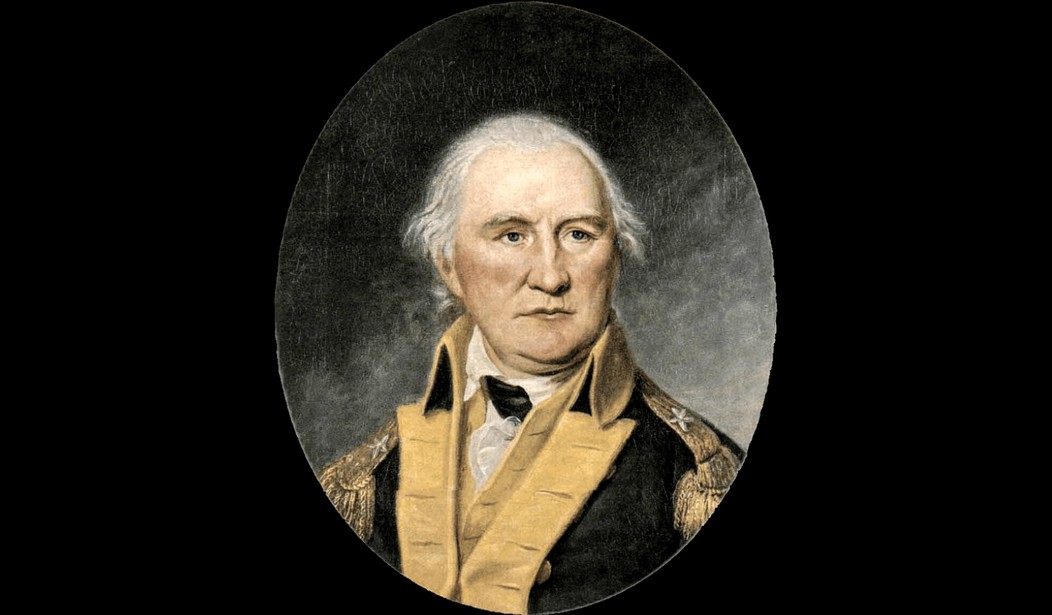
Daniel Morgan was a hard case from the start. He ran away from home at 17 after a fight with his father, finally settling in the Shenandoah Valley of Virginia. He cleared land, ran a sawmill, and eventually built up a successful business as a teamster. As such, he was hired by the British army during the French and Indian War, accompanying Gen. Edward Bradock on his ill-fated campaign against Fort Duquesne.
Apparently, a British officer’s arrogant criticism reminded Morgan of his father, and so he told the redcoat what he could do with his smart talk. The officer hit Morgan with the flat of his sword, and the rough-hewn frontiersman laid him out flat; boom-boom. For that he was sentenced to 500 lashes, which was often fatal. He joked the rest of his life that they miscounted, giving him only 499, and that they owed him one more.
Going back to wagoneering, Morgan spent much of his earnings drinking, gambling, and seeking the company of women engaged in the oldest profession. He was from time to time brought up on charges of assault, horse thievery, and burning down the tobacco barn of a neighbor who got on the wrong side of him. Eventually, having expelled some of his youthful demons, he settled down and married Abigail Curry, who would finally teach him to read and write.
Morgan could not stay away from the action, though, and joined a company of rangers that helped relieve Fort Edwards and later defended it. Outside the fort, he was ambushed by French-allied Indians, taking a musket ball through the back of his neck that went through his left jaw, taking several teeth with it, causing him discomfort for the rest of his life.
When the American Revolution broke out, Morgan was chosen by his county to lead a rifle company to join Washington outside Boston. In November 1775, Morgan’s riflemen joined Benedict Arnold in his failed attempt to take Quebec. It was Morgan and his men who got the farthest into the city, and when finally cornered, Morgan gave his sword to a nearby priest rather than to the British. In January 1777, he was exchanged.
For his bravery at Quebec, he was promoted to Colonel and given command of the Provisional Rifle Corps. These men were armed with RIFLES, slow to load, no bayonet lug, and mainly designed for hunting, but unlike the smoothbore “Brown Bess” everyone else carried, accurate at over a hundred yards. They were essentially the forerunner of scout-snipers, used for reconnaissance, and the peculiar American habit of taking out enemy officers at distance.
Oct. 7, 1777, Bemis Heights, Near Saratoga, N.Y.: A British general, upon his grey horse, was rallying his men in the face of the American assault. According to some accounts, Morgan gave an order to Timothy Murphy, one of his riflemen: “That gallant officer is General Simon Fraser. I admire him, but it is necessary that he should die. Do your duty.” Murphy climbed a tree, and his third shot finally took Fraser out of the saddle, mortally wounded. The British broke. The victory at Saratoga brought the French to our side.
Not used to the politics of promotion and being a frontiersman, Morgan was overlooked, and in frustration resigned from the Army. After Gates’ disaster at the Battle of Camden, however, Morgan was convinced to rejoin with his riflemen, finding himself under the command of someone who appreciated his raw talent — Nathaniel Greene — and promoted to Brigadier General.
Greene hatched a daring plan. He ordered Morgan to take about 600 men, split off, and harass the British, while Greene rebuilt the Southern Continental Army. Cornwallis, in turn, ordered Col. Banastre “Bloody Ban” Tarleton (known for his refusal to give quarter to Americans) to track down this upstart and destroy him. Morgan picked up some militia along the way, and then turned to face Tarleton at a field in South Carolina called the Cowpens. It was there that this barely literate American backwoodsman planned and executed a battle that is studied to this day at West Point and similar training grounds, and has been compared to the likes of Hannibal at Cannae.
Jan. 17, 1781, Cowpens, S.C.: Morgan placed his men with a river to their rear, so that they, and Tarleton, would know there was no place to run. He knew Tarleton disdained the fighting capacity of militia, and his arrogance would lead him straight at them. He also knew Tarleton was right; militia can’t be expected to stand and fight against professionals with a bayonet. The night before, Morgan went among the militia camps and told them that all he asked was for them to fire a couple of volleys, and then they could retreat in good order before the redcoats reached them. That’s all he asked of them – just a couple of volleys.
Upon his arrival on the field, Tarleton could see the riflemen skirmishers, and behind them the militia, but what he DIDN’T SEE was a solid line of Continental regulars behind them on the reverse side of a slope. As expected, he ordered his men to charge headlong. The riflemen in front and in the wooded flanks picked off as many officers as they could, then fell back. The militia fired their two volleys, and seeing their backs, the redcoats picked up speed, exhausting themselves along the way. Then they ran smack into the Continental line. At some point there was a mistaken order to retreat, and in good order the Americans did so.
Seeing it was not a rout, Morgan took advantage of it. As the British closed within a few paces, the American line halted, turned about, and let loose a tremendous volley that virtually leveled the first few redcoat ranks. “Charge bayonets!” came the next order. Meanwhile, the retreating militia circled around to the British left flank while American cavalry hit the right, in a perfect double envelopment. The American bayonets came on, like reapers in a field. Tarleton and his immediate command had to ride for their lives.
The defeat infuriated Cornwallis, who burned or abandoned much of his supplies so that he could travel as fast as the Americans, but he could only catch up to them at the Battle of Guilford Courthouse, which was essentially a draw. Eventually, Cornwallis had to put into a port so that he could be resupplied. The place he chose for that was Yorktown.
The scriptures speak of an unlikely hero raised up to accomplish great things with just a few men in the right place at the right time. His name was Gideon. Daniel Morgan was an American Gideon.
Editor's Note: President Trump is fighting to ensure America's kids get the education they deserve.
Help us fight back against Big Government waste and restore power to the states. Join PJ Media VIP and use promo code FIGHT to receive 60% off your membership.




Join the conversation as a VIP Member