


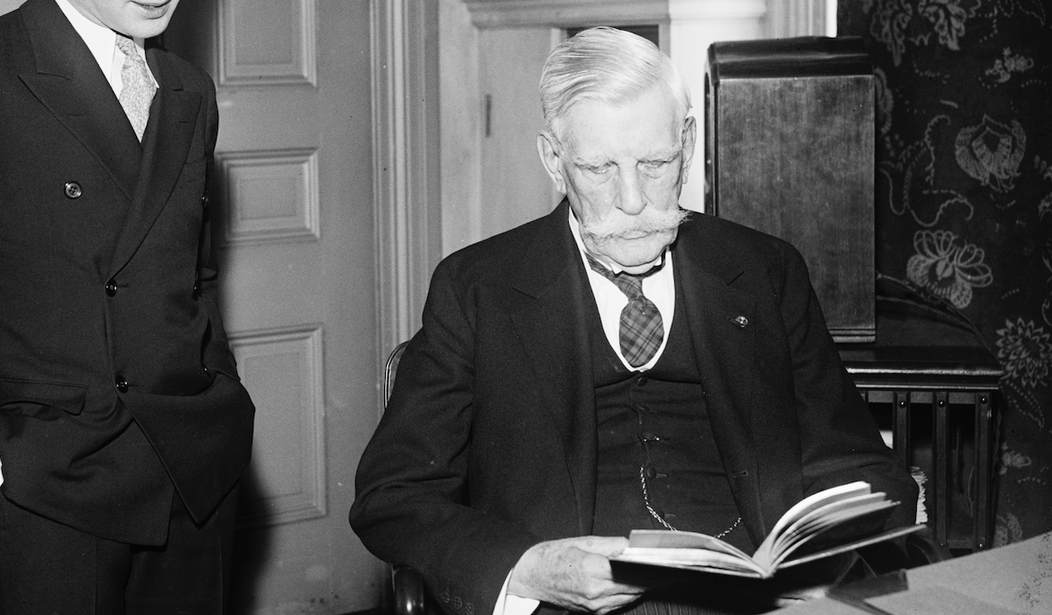
“It is the special care of the Promotor Fidei (Promoter of the Faith, a.k.a. Devil’s Advocate) to prevent any rash decisions concerning miracles or virtues of the candidates for the honours of the altar.”
— Catholic Encyclopedia
I recently pulled out my dog-eared volume of Catherine Drinker Bowen’s hagiography of Oliver Wendell Holmes, Jr., Yankee from Olympus. I smiled, and memories flooded back, seeing the pencil underlining I made as a teenager reading this while tending my father’s corn and vegetable stand in Massachusetts. I felt at home in his world, though he was a “Boston Brahmin” (a term his father coined) and I was a lowly “Swamp Yankee.” I was then at the beginning of my understanding of the “Great Dissenter.” Later as I read his The Common Law and went to law school myself, I got deeper into his complexity and the controversy surrounding him.
He was called the “Great Dissenter” not for the sheer number of his dissents (his colleagues dissented more than he did), nor because he enjoyed dissenting. He hated it. He did not care for the reaction he got on occasion either. His first significant dissent in Northern Securities v. U.S. caused the president who nominated him, Teddy Roosevelt, to say of him, “I could carve out of a banana a judge with more backbone than that!” His dissents became great due to his command of the English language and the fact that so many, at least half a dozen, were eventually favored in overturning the cases in which they were found.
His detractors say there is a whiff of Nietzsche about him, or even of nihilism. They will first point to the largest stain upon his reputation, his majority opinion in Buck v. Bell, the forced sterilization case in which he wrote coldly “three generations of imbeciles is enough.” This was the heyday of eugenics, the attempt to limit the fertility of those considered “inferior” that was a large part of the Progressive movement (folks today who call themselves “Progressive” may want to give that some thought).
He was not much for “natural law,” and is considered by many to be the father of “the living Constitution,” which conservatives and originalists deride as a sure pathway to legislation from the bench, with no limiting principle.
Yet we often find in his opinions not legislation, but deference to it, at least in the economic cases. In Lochner v. New York, the court invalidated a state law limiting the hours bakeries could require their employees to work, upon the grounds that the “right to contract” was fundamental and protected by the due process clause of the 14th Amendment. In dissent, Holmes noted that:
The 14th Amendment does not enact Mr. Herbert Spencer’s Social Statics… This case is decided upon an economic theory which a large part of the country does not entertain… But a constitution is not intended to embody a particular economic theory… it is made for people of fundamentally different views…
In Hammer v. Dagenhart the court overruled child labor laws. Holmes was straightforward in his dissent: “If there is any matter upon which civilized countries have agreed… it is the evil of premature and excessive child labor…” In the free speech cases, though, we see Holmes taking a stand limiting governmental power. In Abrams v. United States, the court upheld the conviction of a Russian-born American who distributed pamphlets protesting against sending American troops to side with the “White Russians” against the Bolsheviks. Here are the words every first-year law student learns:
I believe the defendants had as much right to publish as the Government has to publish the Constitution of the United States now vainly invoked by them… the ultimate good desired is better reached by free trade in ideas – that the best test of truth is the power of the thought to get itself accepted in the competition of the market…
In Gitlow v. New York, the court upheld a conviction for “advocating criminal anarchy.” Holmes once again was at his best: “Every idea is an incitement… the only difference between the expression of an opinion and an incitement… is the speaker’s enthusiasm for result. Eloquence may set fire to reason.”
Holmes is criticized for not paying much attention to original intent or prior cases, but instead reasoning based upon practicality. His The Common Law is famous for its proclamation that “The life of the law has not been logic, but experience.” Today, are there serious arguments against child labor laws, etc. generally speaking? Can we not agree, as did John Stuart Mill, that truth is best shaped in the “marketplace of ideas”?
There is no doubting the cynicism in many of his writings and decisions. It is clear he was an agnostic. This man was shot through the neck at Balls Bluff, hit in the chest at Antietam, and took a bullet to his foot at Fredericksburg that pained him the rest of his life. He witnessed such an effusion of blood all around him that we could hardly fathom, in a war that took the lives of almost 700,000 Americans. We may not share his cynicism, but perhaps we can afford some forbearance. Of his generation he wrote, “We have shared the incommunicable experience of war, we have felt, we still feel, the passion of life to its top. In our youth our hearts were touched with fire.”
The practicality in Holmes’ legal reasoning was based upon a fear, perhaps borne of his war experience:
Certitude leads to violence. This is a proposition that has an easy application and a difficult one. The easy application is to ideologues, dogmatists, and bullies--people who think that their rightness justifies them in imposing on anyone who does not happen to subscribe to their particular ideology, dogma or notion of turf. If the conviction of rightness is powerful enough, resistance to it will be met, sooner or later by force…
Giving the legislators some “breathing room” to experiment with economic policy, and allowing for a more robust view of the First Amendment, later became the law of the land. Lochner was overturned in West Coast Hotel Co. v. Parrish, Abrams was overturned in Brandenburg v. Ohio, etc., and in many of these cases Holmes’ dissents were quoted.
Surely we are better off, and perhaps we avoided more bloodshed, when later courts heard the echo of that “Devil’s Advocate” who would join his clerks’ discussions, excitedly saying, “Tell me what it’s all about, and I’ll take the other side!”
Editor's Note: Unelected federal judges are hijacking President Trump's agenda and insulting the will of the people.
Help us expose out-of-control judges dead set on halting President Trump's mandate for change. Join PJ Media VIP and use promo code FIGHT to receive 60% off your membership.




Join the conversation as a VIP Member