A couple of controversies that have been swirling around the church world—and even the political world—have made me think about the importance of making sure your Bible translation is solid and faithful. How you read God’s Word is just as important as what you think about Him.
You may have heard of or even been familiar with The Passion Translation (TPT). It’s the brainchild of a pastor named Brian Simmons, who is affiliated with the heretical, dangerous New Apostolic Reformation (NAR), and it reflects a lot of the problems with that movement.
The FAQs for The Passion Translation explain the idea behind it:
About every hundred years or so, the vocabulary of people undergoes a dramatic change. In this era of modern technology, we find an even more rapid shift. Therefore, it is important to keep translations of the Bible in step with changes in the English language. That’s where The Passion Translation comes in. The goal of the translators of The Passion Translation is to bring God’s fiery heart of love and truth to this generation, merging the emotion and truth of God’s Word, resulting in a clear, accurate, readable translation for modern English readers.
God refuses to meet us only in an intellectual way. God also wants to meet us at a heart level, so we must let the words go heart deep—which is what the translators are trying to do with this project. There is a language of the heart that must express the passion of this love-theology.
There are two problems with that paragraph, and they boil down to two words: “accurate” and “translators.” For starters, the vast majority of Bible translations rely on a large, identifiable translation committee representing multiple scholars and theological traditions to ensure that the translation gets God’s Word right. TPT is almost exclusively the work of Simmons.
Journalist Daniel Stillman reported last month that Simmons asked scholar Rick Wadholm to consult on TPT, but Simmons barely listened to any suggestions. Stillman wrote that “Wadholm said he had no oversight or editorial control. He does not know how Simmons reached any of the decisions he made about the final version of the text that Broadstreet published.”
And then there’s the issue of accuracy. Simmons embellishes the language of God’s Word and deliberately adds emotional and interpretive language that is not present in the underlying text. He relies on Aramaic translations of the Bible, and scholars say that Simmons isn’t even translating accurately from Aramaic, which is the original language for only a few sections of the Bible.
Simmons’ additions to the text were particularly numerous in the Psalms. Andrew G. Shead discovered that the Psalms in TPT were roughly 50% longer than in mainstream translations.
On top of everything else, Simmons faces charges of plagiarism over TPT. Stillman explained:
A nondenominational pastor in Texas said he found 500 instances of theft in the Passion version of Luke alone.
David Fish, formation minister at New River Fellowship, 25 miles west of Fort Worth, told RR that Simmons steals from popular paraphrases, such as The Message. Many of the footnotes, which are often praised by readers, appear to be taken word-for-word from an obscure filmmaker who claimed Christians had suppressed the true text of the Bible.
Fish published two spreadsheets online with more than 100 examples of borrowed language.
“Smoking gun after smoking gun after smoking gun,” he told [Roys Report, the outlet Stillman writes for]. “How many smoking-gun instances of plagiarism do you need before you pull something and recognize there is a serious problem?”
“To make matters worse, many of the passages were taken from Victor Alexander, a filmmaker whose translation work from the 1990s and 2000s many consider to be unreliable,” adds Plagiarism Today.
As a result of all of the controversies, popular platforms have dropped TPT. Bible Gateway did in 2022, and YouVersion recently took TPT off its website and app. Logos, the Bible software I use and highly recommend, had it on its platform a while back but took it down after user feedback. Stalwart NAR congregation Bethel Church quietly pulled its special edition TPT not long ago.
Another Bible translation controversy centers around James Talarico, the Texas Senate candidate who is the low-hanging fruit of dunking on radical leftists. I wrote about his church and his theology a few weeks ago.
Related: The Left’s New Favorite Christian Politician Has a Theology Problem
The pastor of Talarico’s church gives guests a copy of a translation called The Inclusive Bible. The Inclusive Bible is from an outfit called Priests for Equality, and there’s no denying the agenda behind this version of the Bible. Here’s what the description of that heretical translation has to say about itself:
While this new Bible is certainly an inclusive-language translation, it is much more: it is a re-imagining of the scriptures and our relationship to them. Not merely replacing male pronouns, the translators have rethought what kind of language has built barriers between the text and its readers. Seeking to be faithful to the original languages, they have sought new and non-sexist ways to express the same ancient truths. The Inclusive Bible is a fresh, dynamic translation into modern English, carefully crafted to let the power and poetry of the language shine forth—particularly when read aloud—giving it an immediacy and intimacy rarely found in traditional translations of the Bible. The Inclusive Bible contains both the Old and the New Testaments.
Two bad translations. One turns up the emotional temperature. The other applies an ideological filter. In both cases, the translators risk approaching scripture with a predetermined destination. Whether the goal is to make the Bible more passionate or more progressive, the translators have ceased to be messengers when they begin correcting the message.
Recommended: James or Jacob? Why the Name Debate Misses the Bigger Biblical Point
This is why it’s important to make sure that your Bible translation is accurate and faithful. There are two philosophies of Bible translation: formal and functional. Formal seeks to stay as literal and faithful as possible to the original languages, sometimes at the expense of syntax and readability. Functional seeks context and contemporary readability, sometimes at the expense of literalism. There are also paraphrases, which are, well, paraphrases.
ChatGPT gave me a handy-dandy chart that explains which modern translations lean one way or the other:
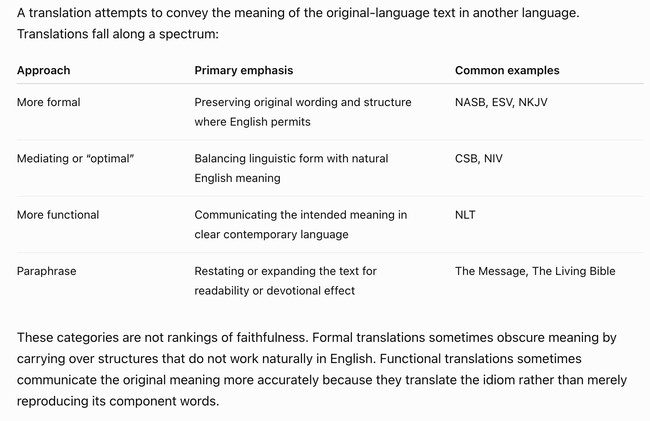
Side note: The KJV is its own category. I hope the KJV-only folks don’t get too offended with me, but the KJV’s principal limitations arise not from carelessness but from age. The KJV was completed in 1611, using the Hebrew and Greek texts available to scholars at the time and an English vocabulary that has changed considerably over four centuries. Some familiar words have become obscure, while others remain in use but no longer mean what they meant to the KJV’s translators. Modern translations also benefit from older manuscripts and centuries of additional textual and linguistic scholarship. That said, the KJV can still be useful and is still beautiful.
I’m a big fan of the ESV. It’s a great translation for study, and it retains a more formal structure that can occasionally get clunky. I’ve just begun checking out the CSB, which hits a sweet spot between accuracy and readability.
I much prefer the NIV84 translation over the 2011 NIV, but it’s a good blend of readability and scholarly accuracy. The NLT is also a readable translation that’s still solidly accurate. Other translations worth checking out include the NASB 2020 and the NKJV. I would avoid paraphrases like The Living Bible or The Message for anything heavier than casual reading.
Christians do not need a Bible redesigned to mirror our emotions, our politics, or the reigning assumptions of our age. We need one that faithfully confronts all of them. God’s Word reveals Him to us, guides us in how we should conduct our lives, and calls us to repentance and faith. We should be conforming to the Bible, not conforming the Bible to us.