





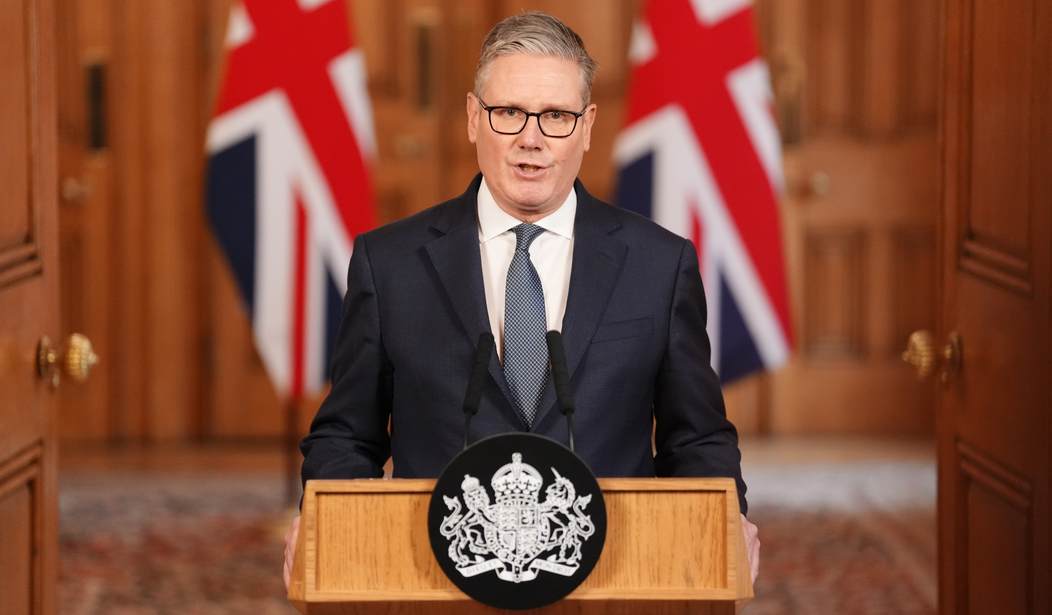
I counted, and during my lifetime, the UK has had 13 prime ministers. The count is likely to jump to 14 soon now that Prime Minister Keir Starmer announced his resignation as leader of the Labour Party on Monday.
Labour is now set for a leadership challenge, with newly elected MP Andy Burnham, formerly mayor of Manchester, as the main challenger. Starmer’s resignation may give rank-and-file Britons (many of whom are discovering the joys of American life during the World Cup) some whiplash, as Noa Hoffman pointed out on Monday’s Coffee House Shots podcast:
I think a lot of people who are not in tune with the day-to-day ins and outs of Westminster politics are going to think, “What the hell is going on?” I think that's actually going to reflect quite poorly on the Labour Party, because, as Tim said, there was no one major scandal or one major failure that really led to this resignation.
It was sort of a litany of errors, many of them unforced, but nowhere near to the extent of what sort of preceded the big resignations of a lot of Tory prime ministers, so no one is going to say Keir Starmer was doing a great, perhaps even good job, but was he literally the worst thing on earth, or so bad to the extent that everyone thought, given even given the volatile state that the world is in right now, the best thing to do is for you to stand down and bring in a man who nobody, apart from the people of Makerfield voted for, nobody in the general election voted Labour on the basis of Andy Banham leading the party and being a prime minister, and now he's promising all these big radical changes, unless he U-turns on them, as he has been doing frequently, without a mandate. So this is going to come as a shock to a lot of people, and I don't think Labour MPs really understand that.
She later said, “But I think the overall question that history will ask is, was that reason enough for him to go and bring on the next sort of big left-wing agenda that we're about to see that the public did not vote for, and I'm not sure the answer to that is necessarily yes.”
Flashback: Confidence in the UK's New Government Is Dropping
This isn’t an apples-to-apples comparison since the UK’s parliamentary system doesn’t exactly line up with the American democratic republic, but it feels like an echo of the Democrats replacing Joe Biden with Kamala Harris. It’s not clear yet how Labour’s rank and file will take to Burnham’s leadership and policies, so it may drive the country closer to a general election sooner rather than later.
In the podcast, the question of Starmer’s legacy came up. Editor Tim Shipman characterized Starmer as one who was good at campaigning but bad at governing — you know, like Barack Obama. Shipman also identified Starmer’s legacy as being much about himself:
The innate thing is that Keir Starmer fundamentally thinks that if you're a decent chap and you're going to work and want to do decent things, then decent outcomes will follow. Well, that's not how politics or government works.
And the other thing he thought was that winning a landslide was some great, massive endorsement of himself, and it was not. It was one of the great two-fingers-to-you [akin to a middle-finger gesture], anyone but the previous lot voters have ever seen in British politics, and that miscalculation, I think, made his government very difficult, and it meant a lot of what he thought he was going to achieve quite easily, like a reset with the European Union. “Oh, which will be fine, because we're not these wicked Tories. We're going to go in, and it's all going to be great, because we're nice and we're Labour.”
The Spectator’s Madeleine Grant had another brutal assessment of Starmer’s legacy. In her view, Starmer represents the great gulf between the elites and the great unwashed.
There will be much commentariat-painting of Starmer as exhibiting decency, competence and integrity. It probably doesn’t feel like that if you were one of the people he pushed under the bus to save himself, it probably doesn’t feel like that to the pubs and businesses and farms and schools shutting down, it probably doesn’t feel like that if you’re a Chagossian, or a military veteran, or a rape gang victim. Indeed, aside from vibes and the fact that he is ‘like them’, it is very difficult to see where those who laud Starmer as decent, competent, and having integrity have got the idea from.
That perhaps is Starmer’s real legacy: to be the man who embodied more than anyone else the vast gap between those who govern and the governed. The prime minister we were told the nation needed turned out to be the one it deserved. Most deliciously of all, Starmer has embodied the absolute reversal of Blair by proving, even in his departure, that things can, and will, only get worse.
The analogies between Labour and U.S. Democrats are plenty, but Starmer and the upcoming leadership challenge highlight two big comparisons. At the party level, Labour and the Dems are ready to go as far left as they can, and Labour leadership sees itself as an elite class that knows better than the governed, much like Democrats today. It’ll be revealing to watch how this will play out over the next few weeks and what the next general election, whenever it may happen, will bring about.
Editor's Note: Do you enjoy PJ Media's conservative reporting that takes on the radical left and woke media? Support our work so that we can continue to bring you the truth.
Join PJ Media VIP and use promo code FIGHT to receive 60% off your membership.
Join the Conversation
VIP members get the ability to comment on articles.