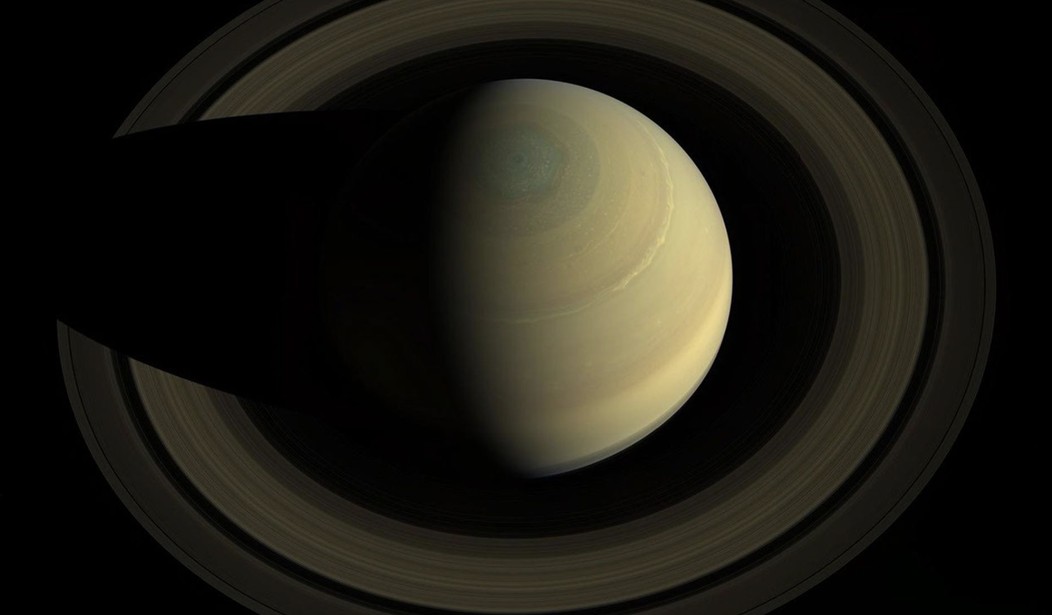

A little bit different soundtrack this week.
Terry Bisson had a story in Omni in April 1991: “They’re Made Out of Meat.” A little excerpt:
“Thinking meat! You’re asking me to believe in thinking meat!”
“Yes, thinking meat! Conscious meat! Loving meat. Dreaming meat. The meat is the whole deal! Are you beginning to get the picture or do I have to start all over?”
“Omigod. You’re serious then. They’re made out of meat.”
So something that came up in Sky Candy on Friday was the spectacular images we see every week, and the sense of wonder we have when we see them.
🆕 Our ESA/Webb Picture of the Month features a glowing and evolving star cluster ✨ Webb has peered through layers of dust to reveal the young stars hidden in NGC 7129, a stellar nursery just 3,300 light-years from Earth. 1/3 https://t.co/JUtHLZ6Xcd
— ESA Webb Telescope (@ESA_Webb) October 6, 2026
Someone commented that they’re all false-color images — which is strictly true, but which makes them sound a little trivial.
You see, all these images come from cameras of various kinds. The big telescopes in California, those on a mountain in Hawaii, and those in a special solar orbit opposite the Earth at the L 2 point — like the James Webb Space Telescope — are all specialized cameras of various sorts. (There's a video at the end explaining what the Lagrange points are.)
The naked eye is a camera, too. It’s just made of meat.
Eyes are cameras, but they have slow film and a fast shutter. The light receptors in the eye — the cones and rods — aren’t very efficient. While they can fire — respond to — a single photon, they also don’t respond to all the photons, and once they fire they need time to become sensitive again. (A long time ago, I had to have detailed pictures of my eyes taken with a special camera that flooded the eye with light and fired all my rods and cones, which was effectively like unrolling film in the sun. It took about 15 minutes before I could see clearly again.)
Recommended: Columbus: The Good, the Bad, and the Wrongheaded Reason to Hate Him
Both rods and cones lose sensitivity in a fraction of a second, so if you stare at something longer, the image you see doesn’t get brighter or clearer.
Both old-fashioned film and the modern electronic CCD sensors remain sensitive for a much longer time, and so can simply accumulate more photons, which can then be integrated into an image with much more information than the naked eye can gather. So an image you see in a telescope might be a gray smudge, while a long camera exposure can show the actual colors.
Beyond that, the JWST is sensitive to frequencies the meat can’t respond to at all, in the infrared. So if you could put your eye to a hypothetical eyepiece on the JWST (hold your breath), you’d see nothing at all — all black. So the infrared frequencies are mapped to frequencies we can see, usually by mapping the lower frequencies to red and the higher frequencies to blue, simulating the way the eye responds to visible light.
Recommended: Sunday Supplement: It's Musk's Future, but We'll Live in It
Once we start looking outside the eye’s visible range, however, there’s no need to limit ourselves. As well as JWST’s infrared, which is useful because infrared can penetrate dust that is opaque to visible light — we can move up and down the whole spectrum of electromagnetic radiation. Starting from microwaves at the bottom (radio telescopes) and on up to X-rays (the Chandra X-ray Observatory) and even to gamma rays (like the Fermi Gamma-ray Space Telescope or the brand-new Cherenkov Telescope Array Observatory) at the top.
Like a collage made of layered sheets of colored cellophane, a vibrant new image layers observations of the Tarantula Nebula from NASA's Chandra (blue), Hubble (green), and Webb (red). More: https://t.co/7q1F5LXwgD https://t.co/gMxMGoLqk4
— Chandra Observatory (@chandraxray) August 11, 2026
Related: Summer Supplement: The Seasons, and Little Red Dots
And then we get the really weird things, like the IceCube neutrino telescope we talked about last week.
We can’t any see those either, of course, but the data from them is sometimes mapped to visible light frequencies and added to overall images. One example was in an X post from the Chandra Observatory last August.
The point is that nearly every astrophotograph you see is “false color” in the sense that it’s not what the naked eye would see. What they are is images processed so your naked meat cameras can appreciate them.
And that's it for this week. Thanks for coming, and don't forget Sky Candy next Friday, and another Sunday Supplement next week.
Oh, and don't forget to comment, especially if you have questions I can address in future columns.
Recommended Videos
If only Dr. Becky were in Wichita...
Not Betelgeuse, darn it.