


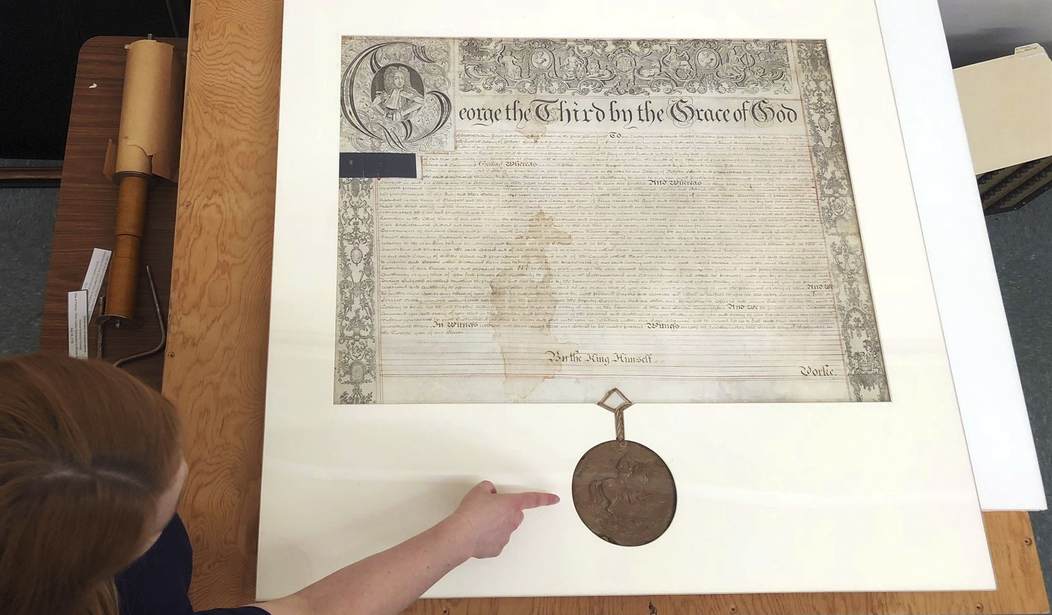
Exactly 250 years ago to the day (August 10), King George III of Great Britain found out that the American colonies, through the Continental Congress, had declared themselves free and independent states.
While nowadays important political events are broadcast to the world online or on TV practically as soon as they occur, or even as they are happening, in the late 18th century news could take months to travel, especially across an ocean. The Continental Congress voted for independence on July 2, 1776, approved the Declaration of Independence on July 4, and began the official signing of the Declaration on August 2, but the news didn’t reach England until after all these events were past.
The Jack Miller Center explains that the reaction to the Declaration of Independence in England ranged across the gamut of indifference, disdain, hope for its ultimate rejection, and rage.
News of the Declaration of Independence reached Great Britain in August 1776 and ignited a media frenzy. Many newspapers published the full text of the document, albeit without comment. Others, like The Scots Magazine, printed the declaration with accompanying, often sarcastic, editorial asides. One commentator attacked “unalienable rights,” as the “unalienable right of talking nonsense.” … British merchants feared losing the American colonies in a “lasting and ruinous Civil War,” but King George III remained optimistic. As the “driving force behind the hard-line” taken by the British, the king believed that his military forces would soon quell the rebellion. After all, these forces were already stationed in America. Moreover, George III viewed himself as a benevolent monarch and paternal figure, one whom American colonists adored and toasted each year on his birthday.
Like many a dictatorial and elitist royal throughout history, George III saw himself as so superior to ordinary men, so eminently wiser and blessed directly by God with vast power, that he couldn’t even honestly face the possibility that his colonists might be more in the right than he. Of course any decision he made was correct—he was ruler of an empire! His overweening pride and love of power were also why, so many years later, the king would be thoroughly confounded to hear that George Washington had turned down a crown.
King George’s reply to the Declaration expresses his willful blindness and pride in every line. “When subjects, forgetting the duties of obedience and gratitude, presume to arraign their lawful Sovereign before the tribunal of their own passions, it becomes necessary—not for the vindication of authority, which stands secure in God’s ordinance—but for the instruction of the misled and the correction of error, that the Crown should speak plainly,” he began, and continued throughout in the same vein. The Patriots were “deluded subjects” in his mind.
For Our VIPs: ‘Damn the Torpedoes’: Facing Terrorists With Farragut’s Spirit
In the newly independent states, British commanders Vice Admiral Lord Howe and his brother were also inclined to be arrogantly disdainful. They had just sailed to reinforce British troops in New York against Gen. Washington’s relatively inexperienced and under-equipped men and had addressed offers of pardon to colonial governors, not deigning to address the “rabble” directly. The Howes declared in sneering condescension:
Although the Congress, whom the misguided Americans suffer to direct the opposition to a re-establishment of the constitutional government of these provinces, have disavowed every purpose of reconciliation not consonant with their extravagant and inadmissible claim of independence,—the King’s Commissioners think fit to declare that they are equally desirous to confer with His Majesty’s well-affected subjects upon the means of restoring the public tranquility, and establishing a permanent union with every colony, as a part of the British Empire.
As a matter of fact, Washington’s troops would suffer brutal defeats in New York before the American commander-in-chief pulled off the brilliant wins of the Trenton-Princeton campaign. And at least a third of American colonists were still Loyalists, many of whom would fight on the British side and commit bloody reprisals on Patriots. Looking back now, it is perhaps hard to understand that King George and the Howes seemed to be obviously on the winning side, while the arguments of the Patriots were so radically revolutionary as to border on apparent lunacy for those without the ability to think outside their time.
The visionaries saw a new world dawning. The elitists and cowards saw only one of many self-destructive rebellions. But history vindicated the Patriots and condemned the tyrants.
Editor's Note: President Trump is fighting to ensure America's young people get the education they deserve.
Help us fight back against academic bias and discrimination. Join PJ Media VIP and use promo code FIGHT to receive 60% off your membership.





Join the conversation as a VIP Member