Visiting George Washington’s Mount Vernon, Independence Hall, the National Constitution Center, and other historical museums and monuments this past week for America 250, I had a chance to see how excited children can become about history when they experience it live and interactively.
Patriotic American parents and teachers don’t need me to tell them that there is a massive educational crisis in this country. The question is, how do we solve the crisis? The simple answer in my mind is to restore a Booker T. Washington model of education, combining rigorous classical instruction with manual labor and trade skills. But since that is not easily accessible to everyone, a good place to start is to teach history the hands-on way.
The places I visited are all on the East Coast, but there are museums and historic sites across our country. Furthermore, even if museums are rather too long a drive for your family or classroom, have your kids dress up as cowboys, U.S. soldiers, and famed heroes of our past for holidays and events. Even the smallest town could put together kids' classes or events that include educational videos, historically influenced games, crafts, and food cooked with traditional American recipes.
Probably the most consistently reliable (i.e., non-woke) museum I visited in the last few days was the National Museum of the U.S. Marine Corps, which is in Triangle, Va. I have always loved this museum because it has dozens of life-size figures, some of them statues people can touch and others set up in historical backdrops for specific battles. There's a kids’ area for play-acting at being among Revolutionary War-era "Leathernecks" and some of the life-size displays are interactive, especially the Chosin Reservoir room, where the walls blast cold air and simulate gunfire while different Marines around the room huddling in "snow" take turns talking about the trials of the infamous Korean War campaign.
This museum also has two fairly new sections, showing Marines fighting the Soviet Union and the war in Afghanistan. Given the focus on wars, this museum might be better for older children or teens. Not too far a drive away is the National Museum of the U.S. Army, which has a similar set-up and interactive theme.
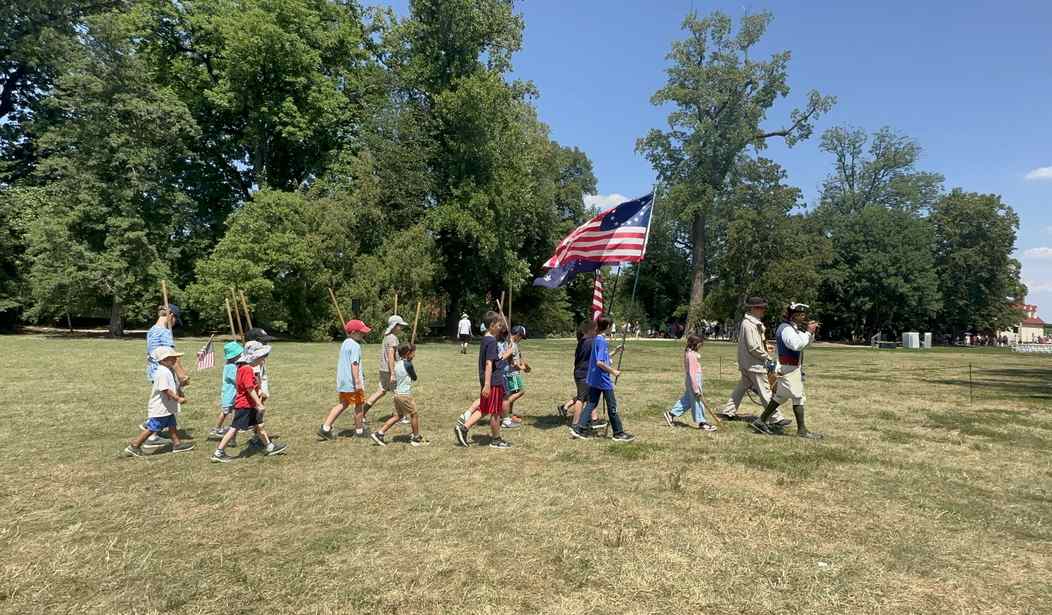
Washington's Mount Vernon is unfortunately becoming more woke, but there are still many excellent docents and great activities for kids. On July 4, the resident fifer was teaching kids how to march and beat drums in the 18th century military style. Reenactors dressed as George and Martha Washington, Nathanael Greene, and other important individuals connected to the estate held meet-and-greets where they talked to kids and teens about the Revolution and colonial America. I stood in line for the mansion tour with a little boy wild with excitement to buy a toy musket and tricorn hat. Another family of boys was thrilled to see real cannons set up on the lawn. Families learned 18-century dances that the Washingtons loved. It was exactly the sort of unforgettable experience that will help cement in young minds the historical facts that came wrapped in so much fun.
🇺🇸 🇺🇸 We had an absolutely amazing day today at Mount Vernon! We thank everyone who visited (so many braved the heat!) and helped us celebrate the 250th anniversary of United States! Happy 4th of July!🇺🇸 🇺🇸
— Mount Vernon (@MountVernon) July 4, 2026
Thank you to Boeing for sponsoring this event pic.twitter.com/7ZprhlVw1L
Related: America 250 Fireworks: Lighting the Sky at Washington's Mount Vernon
The National Constitution Center is wokified in many galleries, so I mention it with a note of caution. The most crowded room in the museum, however, was the signers' hall with statues of the more than 50 delegates to the Constitutional Convention. Kids and teens were "shaking hands" with statues, posing beside them, and running from plaque to plaque to see what the names of each of the men were. Little kids painstakingly traced their name on the screen with the "sign the Constitution" program. Videos and signs helped kids understand some of the basic facts about the Constitution and the Bill of Rights. All the young people found the hall exciting — suddenly the men who hammered out the Constitution were not names in books or dull classes. The statues made those long-dead men seem real and relevant.
There were families at the Babe Ruth Birthplace Museum in Baltimore who were baseball fans, and kids crowded around displays in Philadelphia’s Weitzman National Museum of American Jewish History. The Benjamin Franklin Museum was similarly smart to have dozens of interactive displays where kids could touch, hear, and look at different Franklin inventions. Also in Philadelphia, children stood in line for two hours with their parents to see Independence Hall and crowded at the rail inside the hall to stare big-eyed at George Washington’s chair from the Constitutional Convention and the desks set up for the Continental Congress.
The examples are endless, but you get the point. And again, if you live in an area where reenactments and museums are scarce, why not start a new tradition? I’ve held dinners with ancient Roman or colonial American dishes, and kids live to take toy guns and play at being soldiers or Marines. My pastor holds movie nights with films based on real-life U.S. heroes. Give ideas to your local school or church or scouting troop.
As a Virginia teacher told me, “One of the things so hard about teaching history is that it’s abstract and foreign to their experience, so anything you can do to make it more concrete so that they can conceptualize it helps. Then it’s amazing to see the connections they can make.”
And understanding the past is vital to our future.