





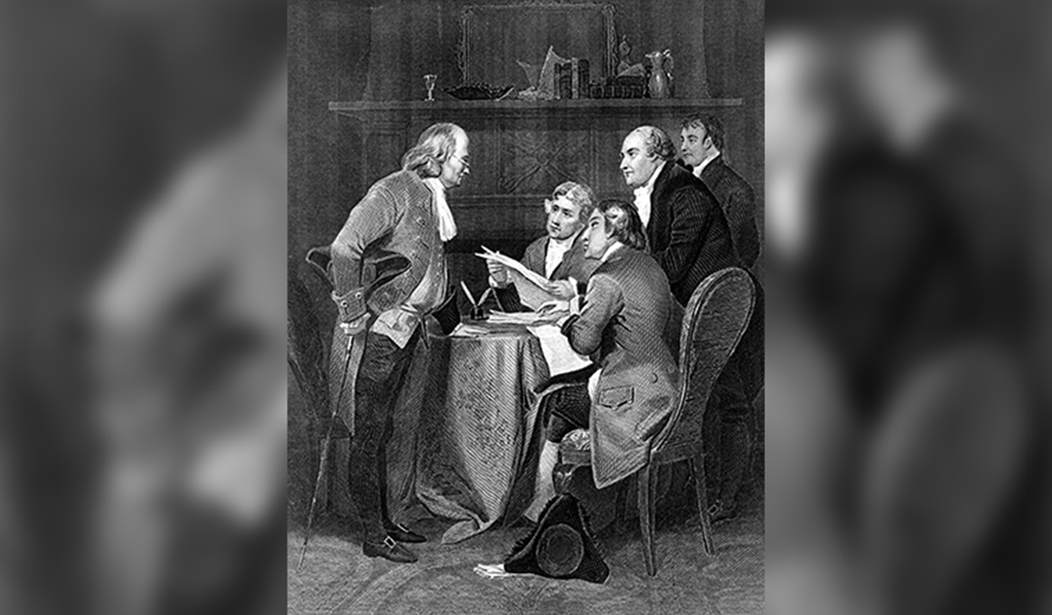
Exactly two and a half centuries ago on Sunday, Thomas Jefferson, with the help of the other members of the Committee of Five, completed a draft declaration that would soon make history.
The Continental Congress was split on the question of independence that summer of 1776, with some of the delegates pushing for independence, some of the delegates insisting it was much better to hope their rebellion against Britain would be a short one ending in reunion, and still others undecided. But in spite of this great uncertainty about the outcome of a vote on independence, Congress authorized a Committee of Five to write up a declaration explaining the reasons for separating from Great Britain should it become necessary.
The men on the committee were Thomas Jefferson, John Adams, Benjamin Franklin, Robert R. Livingston, and Roger Sherman. For a significant part of June, Jefferson was laboring over the declaration with edits and suggestions from Adams and Franklin.
True, the group of men could not be certain that Congress would actually vote for independence. As late as July 1, it seemed as if independence might not happen at all. The independence coalition needed Delaware's vote, and when it came to the proposal from Virginian Richard Henry Lee that “these united colonies are, and of right ought to be free and independent states,” the two Delaware delegates in Philadelphia at the time (Thomas McKean and George Read) disagreed with each other.
Had Delaware delegate Caesar Rodney not ignored his bad health and a thunderstorm to ride 18 hours through the night in order to reach Philadelphia by July 2 to break his state’s deadlock, the declaration probably would never have seen the light of day, or at least would have been much delayed. Yet already by June 28, there was a draft declaration ready and waiting for a small group of men to make history.
After all, to vote for independence could mean marking themselves out for ignominious execution as traitors should they lose in the field to the British troops. Some of those delegates who voted for independence or who signed the declaration were later killed or lost their property or family members to the war. They truly were staking their lives, their fortunes, and their sacred honor.
The National Archives explains:
Jefferson drafted the statement between June 11 and 28, submitted drafts to Adams and Franklin who made some changes, and then presented the draft to the Congress following the July 2nd adoption of the independence section of the Lee Resolution. The congressional revision process took all of July 3rd and most of July 4th. Finally, in the afternoon of July 4th, the Declaration was adopted.
Under the supervision of the Jefferson committee, the approved Declaration was printed on July 5th and a copy was attached to the "rough journal of the Continental Congress for July 4th." These printed copies, bearing only the names of John Hancock, President, and Charles Thomson, secretary, were distributed to state assemblies, conventions, committees of safety, and commanding officers of the Continental troops.
In spite of the congressional indecision about independence, Patriot troops had been in the field for over a year by that time, fighting the British. What would become the United States Army, Navy, and Marines already existed. But with the vote for independence, the cause became clearly defined, not a rebellion demanding some concessions from the government overseas, but a passionate effort to achieve new national sovereignty.
Related: Monmouth and America 250: When Washington Saved the Revolution
George Washington insisted that each brigade in his army hear the Declaration of Independence read aloud. The men cheered it. They were proud to be not English rebels, but Americans.
The National Archives adds:
On July 19th, Congress ordered that the Declaration be engrossed on parchment with a new title, "the unanimous declaration of the thirteen united states of America," and "that the same, when engrossed, be signed by every member of Congress." Engrossing is the process of copying an official document in a large hand. The engrosser of the Declaration was probably Timothy Matlock, an assistant to Charles Thomson, secretary to the Congress.
On August 2nd John Hancock, the President of the Congress, signed the engrossed copy with a bold signature. The other delegates, following custom, signed beginning at the right with the signatures arranged by states from northernmost New Hampshire to southernmost Georgia. Although all delegates were not present on August 2nd, 56 delegates eventually signed the document.
Ironically, Livingston, who had been part of the drafting committee, never did sign the declaration officially.
As we approach the anniversary of America’s 250th birthday, we must honor the men who risked everything to declare that “all men are created equal, that they are endowed by their Creator with certain unalienable Rights, that among these are Life, Liberty and the pursuit of Happiness.”
Editor’s Note: Every single day, especially in this 250th year of America’s existence, and just before this historic July 4, here at PJ Media, we will stand up and FIGHT, FIGHT, FIGHT against the radical left and deliver the conservative reporting our readers deserve.
Help us continue to tell the truth about the Trump administration and its successes. Join PJ Media VIP and use promo code FIGHT to receive 60% off your membership.
Join the Conversation
VIP members get the ability to comment on articles.