


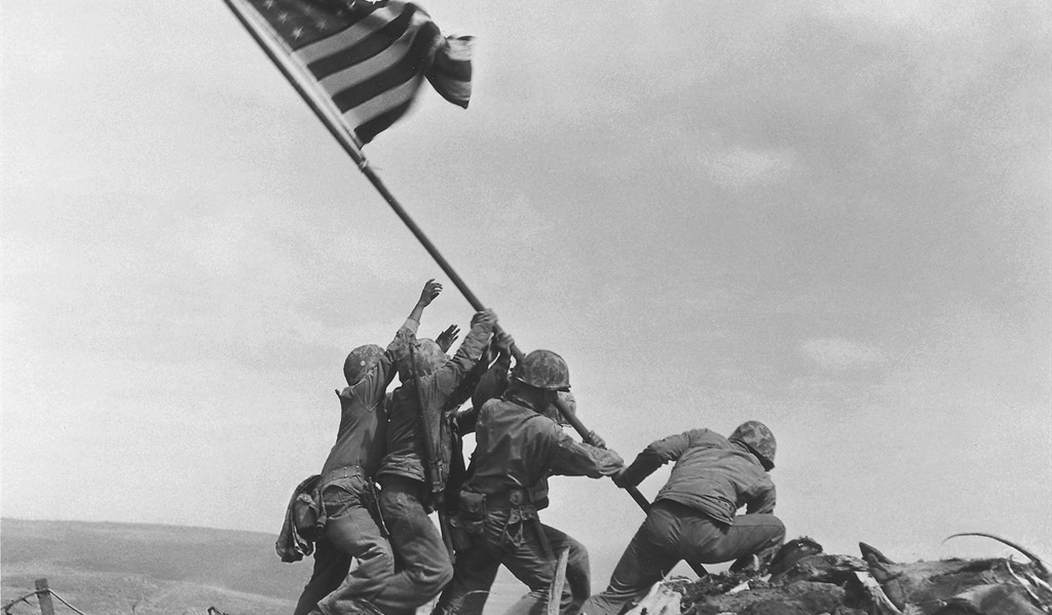
More than eight decades ago today, on Feb. 23 of 1945, a group of U.S. Marines raised an American flag on the bloodsoaked soil of Iwo Jima while a photographer captured an image that would become one of the most iconic in American history.
Nearly 7,000 American Marines died during the Battle of Iwo Jima, along with some 18,000 Japanese soldiers, according to The National WWII Museum. Those who wish to understand why America had to drop the atom bomb should study the horrendously bloody battles for each Japanese island, and the Japanese imperial leadership’s determination truly to fight to the last man, woman, and child rather than surrender. That is the historical backdrop of the iconic flag-raising on Iwo Jima, which is especially important since more than one Marine in the photo died during WWII.
There were two flag-raisings on Iwo Jima on Feb. 23, 1945, and sometimes the Marines who participated in the earlier but less famous one, though it was equally fraught with danger, were disappointed that their fellow Americans did not recognize their achievement too. That flag-raising also occurred on the summit of Mount Suribachi, according to AMAC, but it was the second and much larger flag — which you can still see in the National Museum of the Marine Corps to this day — raised that afternoon that made for the marvelous picture-perfect moment.
The original flag raised on Iwo Jima on this day in 1945 pic.twitter.com/KTqC0dX1tK
— Catherine Salgado (@CatSalgado32) February 23, 2025
Read Also: Military Miracles: When George Washington Almost Lost His Life Through Supreme Daring
Associated Press photographer Joe Rosenthal snapped a Pulitzer Prize-winning photo of six Marines raising the larger flag on Suribachi’s summit. That image is immortalized in a monument in Arlington and many smaller monuments, books, and Marine memorabilia. But who were the men in the picture, the American heroes who fought so hard to reach that summit? EBSCO provides the following list:
• Michael Strank (1919–45), US Marine Corps sergeant
• Franklin Sousley (1925–45), US Marine Corps private first class
• Ira Hamilton Hayes (1923–55), US Marine Corps corporal
• Harlon Block (1924–45), US Marine Corps corporal
• Harold Schultz (1926–95), US Marine Corps private first class
• René Gagnon (1925–79), US Marine Corps Private First Class
It was previously believed that two of the men were John Bradley — who participated in the earlier flag-raising — and Henry Hansen. Evidence later indicated those Marines in the photo were Schutlz and Block instead. Hayes, Bradley, and Gagnon survived WWII and participated in war bond drives and morale-boosting events, but Hayes, a Native American Indian from Arizona, always felt that he shouldn't have been feted and that the greatest heroes were his comrades who never made it home. In fact, according to EBSCO, only five Marines in Hayes's platoon and 25 in his company were not killed or injured in the Battle of Iwo Jima. Like Hayes, Bradley and Schultz disliked talking about their traumatic war experiences.
The flag-raising on Iwo Jima is inspiring but also a sobering reminder of the cost of freedom. Strank, Block, and Sousley all died during the Battle of Iwo Jima, according to Study Country. Hayes had severe PTSD. The Marines who played such a key role in defeating the genocidal empire of Japan paid a high price.
During this 250th year of America’s existence, we should honor the heroes of our past and pass on their stories to new generations.