



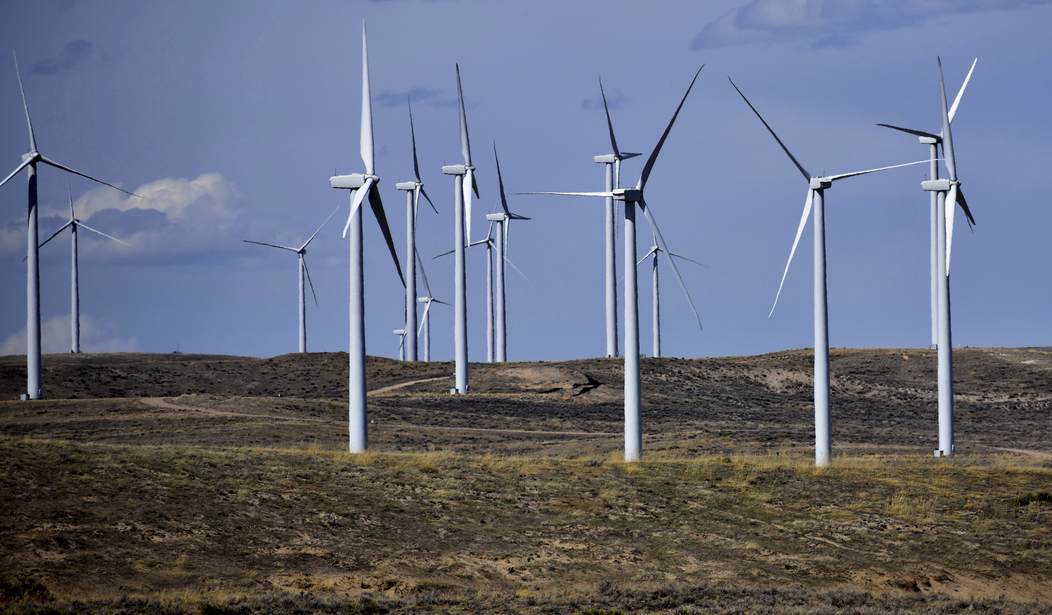
Solar panels and wind turbines are inefficient and unreliable at best, outright catastrophes at worst. When they work the way they are supposed to work, the most they can do is supplement other types of energy, and since they are so expensive, it really is not worth it.
It is rather astounding that though supposed “green” energy is a disaster from every perspective, it has been implemented in so many places. But ideology does trump reality for bureaucrats and ideologues.
Besides being inefficient and unreliable, solar panels and wind turbines take up vast amounts of land. If we were to try and switch our energy grid entirely to solar and wind, it would take up between a third and half of the United States land mass. And that sucks up yet more money, not only to build and maintain the panels and turbines, but also to try and do something with the huge amounts of waste they generate and the land that they ruin.
Energy expert Alex Epstein wrote a recent article highlighting this very issue of cost. “Advocates of solar and wind replacing fossil fuel power downplay the obvious, glaring problem that the grid requires electricity on-demand and that weather-determined, intermittent solar and wind can provide nothing resembling that,” he said. “They either don’t mention intermittency or claim it’s easily addressed.” He cited Elon Musk, who loves to claim solar panels, for instance, can store “excess power” during the day.
Read Also: Muslim Terrorists Start Ramadan by Calling for Global Jihad
The problem is that solar doesn’t usually even generate the amount of power necessary during the day, and the idea of excess power that can be released at night or during storms is mostly a fantasy.
Epstein explained:
But this is a perversion of the proper meaning of “capacity.” For traditional, reliable power plants—nuclear, coal, gas, oil—“capacity” is the amount of electricity it can generate on-demand, when needed. For solar and wind, “capacity” is the maximum potential electricity it can generate when there are perfect weather conditions. Storm Fern showed how in real-world conditions, solar and wind’s “capacity” is an illusion.
I frequently remember being in Scotland and driving into a small rural village which our tour guide mockingly called the “village of optimism,” because so many houses had solar panels… in Scotland, where it’s almost continually rainy or cloudy. Solar panels, unsurprisingly, do not produce energy when it is dark out or there is awful weather, and wind turbines require the right windy conditions.
So-called green energy is toxic for the environment, killing wildlife including birds and whales, and it is also dependent upon abusive and child labor in both Africa and China.
Interestingly, Always on Energy Research estimated in a study last month that New Englanders could end up saving up to $707 billion in the next 25 years if woke authorities rejected "renewables" in favor of gas and oil instead. During the recent severe winter storms, emergency coal power kept the lights on. Solar and wind certainly couldn’t. They cost too much for too little return.