


In February, 1776, Gen. George Washington won a battle with the Continental Congress that emphasized the importance both of religious freedom and of religious practice in public with government support.
One of the favorite phrases in modern political discourse is "separation of church and state," which in fact does not appear at all in the Constitution. The phrase comes from a letter by Thomas Jefferson, who was less religious than many of the other Founders but still believed in the importance of Biblically-based morals in the public square. Nowadays, the phrase is consistently and continually misinterpreted, and today's anniversary helps us understand what the Founders really meant by so-called separation of church and state and what they did not mean.
Anyone who reads George Washington's speeches and reflections on the Revolutionary War knows that he firmly believed God guided and helped the Americans. Washington, a devout Christian, always urged his fellow patriots to give credit for any victory to Providence, and in trouble to turn to the same Divine source for aid. As he would say years later at the close of his presidency, "Of all the dispositions and habits which lead to political prosperity, religion and morality are indispensable supports. In vain would that man claim the tribute of patriotism, who should labor to subvert these great pillars of human happiness, these firmest props of the duties of men and citizens."
Related: George Washington, Divine Providence, and the First Presidential Election
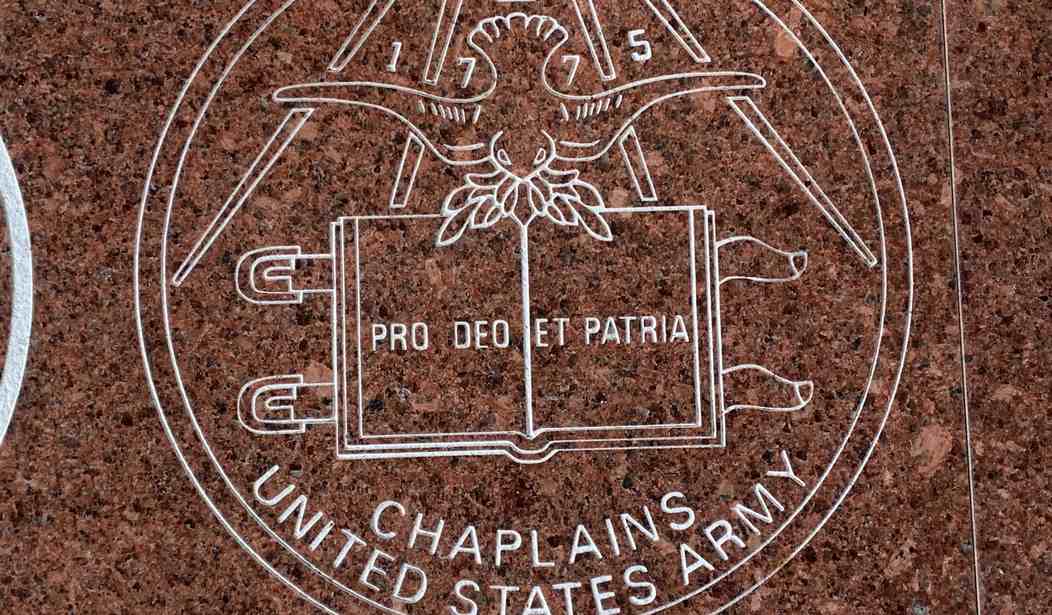
It is no surprise, then, that he thought a military chaplaincy indispensable to his Army. Historian Tara Ross explains that the Continental Congress established salaries for official Army chaplains back in 1775, around the same time that Washington himself assumed command. But Washington believed the salary of $20 a month was "too Small to encourage men of Abilities" to become chaplains. After all, these men were not simply taking a job; they were becoming part of the Army and all its travels and vicissitudes. Furthermore, it is obvious Washington was concerned that he might not be able to secure chaplains of the highest moral and intellectual caliber if the chaplaincy were not treated as more important.
Washington, therefore, lobbied for an increase in chaplaincy salaries. In February 1776, Congress compromised with an increase in pay of $33 a month but meanwhile requiring chaplains to take charge each of more than one regiment. The commander-in-chief was pleased that he had secured political recognition of the spiritual needs in his Army.
Not that the saga ended quite with that reform, because Washington soon began to worry that chaplains were spread a little too thin with multiple regiments to guide, as Ross notes. Congress responded by assigning one chaplain per brigade, which is still larger than a regiment. It was at this juncture that Washington made clear why he was so determined to have as many chaplains as possible. For him, it was a matter of religious liberty, and a deep concern that with too few chaplains his Army, which had many adherents of Catholicism, Episcopalianism, Congregationalism, and other Christian branches — along with a few Jews — would not be able to have regular contact and worship with a chaplain of their own faith.
Washington's vision of a chaplaincy corps filled with an abundance of Christian and Jewish religious leaders did not occur during the Revolutionary War, but it has since come into realization in the U.S. armed forces. And how inspiring it is that while facing a shortage of supplies and men, regular battles with the British, and weather-related crises, Washington never forgot to prioritize faith and religious freedom.