





There is an old sickness abroad in the republic, though there is nothing particularly modern about it. Luigi Mangione becomes a folk hero. Karmelo Anthony becomes a cause. Lindsay Clancy becomes, for a substantial portion of the public, less the woman who killed her three children than the tragic object of a national campaign for sympathy. The facts, circumstances, and legal questions surrounding these cases are not interchangeable, nor should they be treated as such. What joins them is something older and more revealing than any particular verdict or political controversy: our recurring appetite to lavish our moral imagination upon the person who did the harm while gradually relegating the people harmed to the margins of the story.
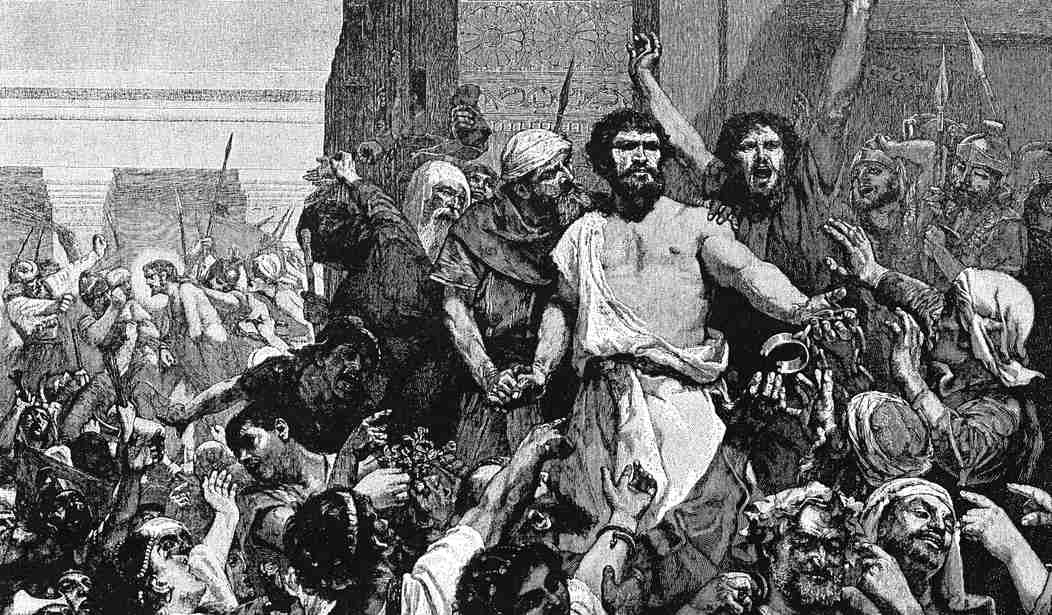
Ecclesiastes warned against the conceit that any generation has discovered some unprecedented form of human depravity: “There is nothing new under the sun.” The technology changes, the vocabulary evolves, and every age invents new theories with which to explain itself, but human nature remains remarkably durable. Two thousand years before TikTok edits, defense funds, psychiatric jargon, revolutionary manifestos, and viral campaigns could convert defendants into cultural celebrities, another crowd gathered before another seat of judgment and was presented with a choice between Jesus Christ and Barabbas. One was innocent. The other was notorious. The crowd knew whom it wanted: “Give us Barabbas.”
Christians rightly understand Barabbas as a picture of substitution. The guilty man walked free while the innocent Christ received his sentence, and in that sense the familiar refrain “I am Barabbas” expresses one of the central truths of the Gospel. We are guilty men and women who live because judgment fell upon Another. Yet there is another dimension to the episode that our sentimental age would do well to recover. Barabbas was not merely the prisoner fortunate enough to benefit from Christ’s condemnation. He was the prisoner the crowd demanded.
Peter later returned to precisely this point when he accused the people of Jerusalem: “You denied the Holy and Righteous One, and asked for a murderer to be granted to you.” His indictment is not incidental to the story. Fallen man does not merely possess the capacity to commit evil; he possesses the more sophisticated capacity to reorganize the moral order around it. He can witness innocence and guilt, cruelty and suffering, righteousness and rebellion, and construct a narrative in which his sympathies nevertheless migrate toward the wrong object. Man is not content to sin. He wants his sins vindicated, his grievances baptized, and his appetites supplied with a philosophy.
Even Barabbas’s name deepens the irony. Bar-Abba means “son of the father,” and some ancient manuscripts of Matthew render his name “Jesus Barabbas." How ironic. The symbolism is difficult to ignore. Before the crowd stood a counterfeit “son of the father” and the true Son of the Father, and the counterfeit proved more attractive. That is one of the recurring dramas of fallen humanity. We do not always reject saviors. More often, we manufacture ones whose terms of salvation are considerably more agreeable to us.
Christ confronts man with sin. Barabbas gives him an enemy. Christ commands repentance. Barabbas offers grievance. Christ locates the deepest disorder of human existence within the human heart; the revolutionary offers the infinitely more flattering possibility that evil resides somewhere outside us, in Rome, in the ruling class, in the institution, in the system, in the people who stand between us and whatever we believe we are owed. One gospel demands the mortification of the self. The other supplies the self with an excuse. It should not surprise us which one has historically enjoyed greater popular appeal.
This is what makes the Barabbas episode so pertinent to the present moment. Modern America is not suffering from an excess of compassion so much as a disordering of compassion, a tendency to make sympathy itself the arbiter of truth. Our culture has become exceptionally proficient at finding the wound behind the wickedness, the trauma behind the transgression, the grievance behind the violence. Sometimes those explanations are necessary and true. But somewhere along the way, explanation ceased to illuminate responsibility and began quietly dissolving it.
Consider the strange cultural life of Luigi Mangione. Whatever one thinks about American health insurance, the fascination that gathered around the man connected to Brian Thompson’s killing quickly exceeded any recognizable concern with health-care policy. The accused became handsome, intelligent, wounded, stylish, politically meaningful, and endlessly worthy of examination, while the dead man was flattened into a profession: “the insurance CEO.” Thompson became an institution, while Mangione was permitted to remain a human being. That distinction is worth contemplating because it captures, in miniature, how moral inversion operates. Reduce the victim to a category, enlarge the offender into a story, and sympathy will soon follow the more interesting character.
Karmelo Anthony has likewise been absorbed into something larger than the killing of Austin Metcalf. What began with the death of a 17-year-old boy became almost immediately a national argument about race, politics, grievance, fundraising, and competing narratives of victimhood. The dead possess a tremendous disadvantage in the economy of modern attention. They cannot explain themselves, cultivate an audience, issue statements, acquire followers, or become symbols of resistance. They leave behind only the stubborn fact of what happened to them, which is often far less useful to political movements than the living person around whom a compelling narrative can be built.
The Lindsay Clancy case presents the most difficult version of the same temptation because the questions surrounding severe mental illness are serious, and human suffering cannot simply be dismissed. Psychosis is real. Psychiatric medicine can fail. The human mind can become terrifyingly disordered. Christianity does not require us to become obtuse about any of that. But neither does compassion require us to forget that Cora, Dawson, and Callan existed, that three young children are dead, and that their deaths should retain moral gravity even amid every legitimate discussion about their mother’s mental condition.
Yet this is precisely where contemporary culture becomes uncomfortable. Simply insisting upon the dead begins to sound severe because we have absorbed the assumption that the highest form of moral sophistication is to identify most deeply with the person whose behavior requires explanation. We are endlessly instructed to ask what happened to the offender before we are permitted to dwell upon what the offender did. The biography expands while the act recedes. The diagnosis grows more intricate while the victim becomes increasingly abstract. Eventually, the very act of judgment begins to seem primitive.
This is the triumph of therapeutic culture, not because therapy itself is illegitimate, but because therapeutic categories have escaped their proper boundaries and colonized our moral vocabulary. Sin becomes dysfunction. Guilt becomes trauma. Restraint becomes repression. Judgment becomes stigma. The language is softer, but the transformation is profound. A civilization that once possessed a vocabulary for both suffering and culpability increasingly possesses a vocabulary only for suffering, and therefore finds itself almost helpless before the ancient reality that suffering people remain capable of doing terrible things.
Christian anthropology is considerably more realistic. Scripture never presents suffering as evidence of innocence. Cain was aggrieved. Saul was tormented. David was wounded. Judas despaired. Human pain and human sin occupy the same fallen heart with uncomfortable ease. A person may have been failed by parents, institutions, medicine, society, or circumstance and still retain moral agency. A man can be oppressed and become an oppressor. A woman can be profoundly ill and leave profound devastation behind her. A criminal may remain an image-bearer deserving humane treatment while his victim, also made in the image of God, possesses a claim upon justice that compassion cannot simply erase.
That complexity should be the natural territory of Christianity. Instead, much of modern culture has adopted a counterfeit compassion that cannot endure competing truths. If the offender has suffered, he must therefore be understood primarily as a victim. If she can be placed within a therapeutic narrative, judgment begins to feel indecent. If sufficient grievance can be established, responsibility starts appearing negotiable. Empathy, properly understood as the capacity to enter another person’s suffering, has been elevated into something altogether different: an epistemology by which emotional identification is expected to tell us what is true.
But empathy is a poor judge. It is easily seduced by beauty, charisma, eloquence, ideology, identity, and narrative. It gravitates toward the suffering that can be photographed, narrated, aestheticized, and made culturally useful. It does not naturally observe proportion. Indeed, sentimentality is feeling severed from proportion, and ours is rapidly becoming a sentimental civilization. We pride ourselves on feeling deeply while increasingly refusing to ask whether our feelings correspond to reality.
The victims are the first casualties of that refusal. Brian Thompson becomes a corporate title. Austin Metcalf becomes a secondary character in a controversy built around someone else. Cora, Dawson, and Callan become the tragic backdrop to a national psychological biography of their mother. We congratulate ourselves on our tenderness while directing the greatest share of it toward the people who remain alive to receive it.
There is something decadent about a society whose sympathies instinctively ascend toward the transgressor and descend away from the innocent. Every functioning civilization maintains what might be called a hierarchy of sympathy. The murdered child has a greater claim upon our immediate moral attention than the murderer’s grievance. The widow has a greater claim than the manifesto. The victim has a greater claim than the political utility others discover in the person who harmed him. This does not preclude mercy for the guilty. It establishes the moral order within which mercy has meaning.
The distinction is crucial because mercy itself presupposes judgment. There can be no forgiveness where there is no guilt, no grace where there is no condemnation, no pardon where there is no offense. Christianity does not offer the therapeutic fantasy that man can be absolved by explaining himself. It offers something far more severe and far more merciful: man is guilty, judgment is real, repentance is necessary, and grace is nevertheless available. Modern sentimentality wants the last proposition while quietly discarding everything that gives it meaning.
This is why Barabbas belongs in the present conversation. Rome was not innocent. Imperial occupation was not imaginary. Jewish resentment did not arise from nothing. Barabbas could undoubtedly have supplied the crowd with grievances, political arguments, and explanations for his rebellion. None of them could make Barabbas Christ. A corrupt system does not make murder righteous. An unjust institution does not transform vengeance into justice. A history of suffering does not confer moral infallibility upon the sufferer. These distinctions sound almost embarrassingly elementary, yet a civilization that cannot maintain them will eventually lose the capacity to distinguish justice from whichever grievance commands the greatest emotional power.
Our age flatters itself that reluctance to judge represents moral advancement. In reality, human beings never stop judging. They merely change the objects of judgment. The culture that refuses to condemn the offender will often condemn the victim instead, particularly when the victim belongs to a politically unfashionable class. The corporate executive becomes greed incarnate. The dead teenager becomes an inconvenient complication in a racial narrative. Anyone who insists upon moral agency is accused of lacking compassion. Judgment has not vanished. It has simply been redistributed according to the sympathies of the age.
Barabbas therefore represents more than the criminal the crowd preferred. He represents the human appetite for counterfeit righteousness, for a moral order rearranged around our prejudices. We should resist the comfortable habit of reading the Passion narrative as though we naturally belong beside Christ looking with horror upon the irrational mob. Scripture offers no basis for such vanity. We are Barabbas because we require undeserved grace, but we are also the crowd because we possess the same crooked ability to discover mitigating circumstances for the sins that flatter our politics and aggravating circumstances for the virtues that offend them.
Give us the revolutionary, if we despise the industry of his victim. Give us the defendant, if his story confirms our preferred account of American injustice. Give us the suffering mother, if acknowledging both her suffering and the full horror inflicted upon her children demands more moral complexity than our sentimental age wishes to bear. Give us the grievance, the diagnosis, the ideology, the sympathetic photograph, the compelling biography, anything that permits us to escape the burden of calling things by their proper names.
There is nothing new under the sun. The great conceit of the digital age is that technology, psychology, and political sophistication have made us fundamentally different from the men and women who gathered before Pilate. They have not. We have built machines of astonishing sophistication and poured into them the oldest passions of mankind: envy, resentment, tribalism, vanity, lust for spectacle, hatred of judgment, and the perpetual desire to make righteousness conform to ourselves.
The courtyard has become a timeline, the mob a comment section, and the grievance now arrives equipped with a diagnosis, a fundraising page, a political constituency, and a viral hashtag. The machinery is new, but the temptation is ancient. We still prefer the savior who validates us to the Savior who judges us, the figure who confirms our grievance to the One who commands our repentance, and the counterfeit righteousness that bends itself around our appetites to the righteousness before which every appetite must bend.
Two thousand years later, Pilate’s question still hangs over the civilization: Which man do you want?
And the world still cries, “Give us Barabbas.”
Editor's Note: Do you enjoy PJ Media's conservative reporting exposing the radical left and woke media? Support our work so we can keep bringing you the truth.
Join PJ Media VIP and use promo code FIGHT to receive 60% off your membership.

Join the Conversation
VIP members get the ability to comment on articles.