



As anyone who has spent time in the Far East will relate to, inquiring Western minds fascinated with the exoticism of the ways of the people there place a heavy premium on aesthetics.
All cultures value aesthetics, of course, but in East Asia and Southeast Asia, it’s taken to an extreme, often at the expense of actual substance.
In Thailand, the professional aesthetic is called looking “smart,” by which they mean well-manicured, well-dressed, and often, if we’re being frank, white.
Related: Converted Pagan Headhunters and the Shining City on a Hill
They love a good white face, so much so that even in the remotest of areas with nary a white person to be found, companies will advertise using white characters.
Like this mural on the wall of a supermarket where I used to procure foodstuffs in a little town in southern Vietnam an hour and a half outside of Saigon that almost no tourist ever visits called Ben Tre, the kind of place where children stare with wide eyes and open mouths, pointing at your face, when you, as a white man, who might as well be an extraterrestrial, ride by on a motorbike.

Related: Converted Pagan Headhunters and the Shining City on a Hill
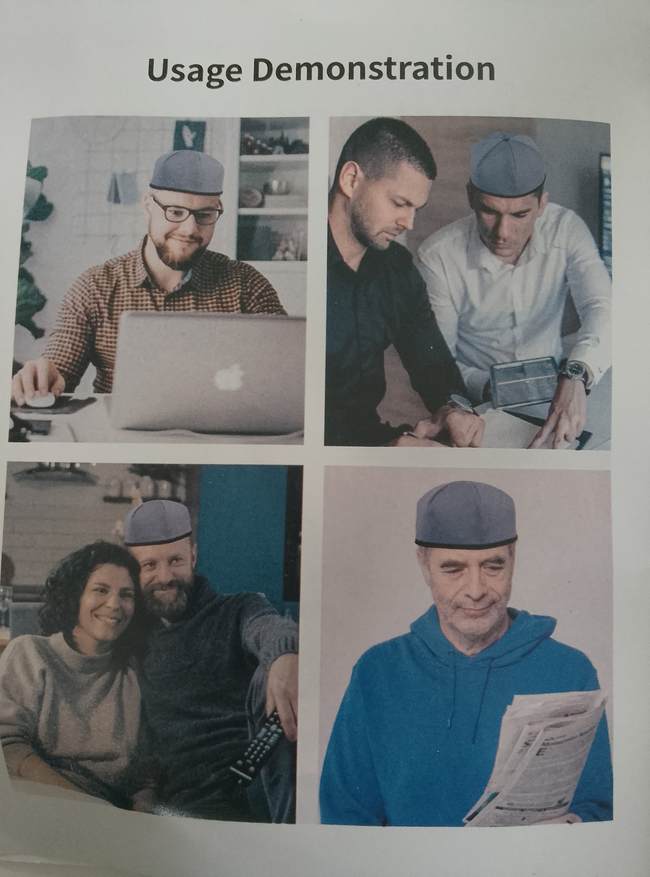
When I ordered an extremely sub-par, knockoff red light cap from China while living in Vietnam — which, incidentally, turned out to be a dud; frankly, by that time I should have known better — it came with an instruction manual in horribly butchered English and stock photos of white people, which the manufacturer presumably found on the internet, featuring their red light product photoshopped onto their heads.
Related: Existential Angst in 'Nam (50 Years Late)
I could, of course, share many more such images of company building edifices, billboards, subway ads, social media ads, etc. that I’ve archived over the years featuring prominently displayed white faces front and center, but I won’t belabor the point; you’ll see for yourself if you ever make the trip.
The psychological effect on the actual white man (me) is to create a lot of pressure to live up to the hype — hence the title of this article, "Asian Advertising and the White Man’s Burden."
As detailed in my groundbreaking expat memoir, available here in paperback and e-book format, a private school in the Bangkok area, at the time so new it hadn’t opened yet and the construction wasn’t even finished, hired me in 2017 as an English teacher.
As there weren’t any students to teach yet, my job became an exercise in surreality.
My instructions were to sit behind a glass display case in my Sunday best and smile at the parents of prospective students whom the administration — specifically, the menopausal retired banker with no educational experience whatsoever tasked with running the operation, who inexplicably wore bright yellow Spongebob Squarepants socks under her heels, Khun Ta — brought in on tours shower with lies, including regarding their high-quality English curriculum, from the British Council that didn’t exist in reality.
From Broken English Teacher: Notes From Exile:
Now that retired-menopausal-banker-turned-head-administrator Khun Ta had been lying to parents of potential students for at least three months about Bangkok Thonburi University Demonstration School's non-existent "fully-developed" English curriculum, the administration had been feeling pressure to display more solid evidence of its bona fides.
So they recruited a single lonely farang (me) for display in a glass case, whose job was to smile to incoming visitors and lie to them about said non-existent curriculum, which was purportedly developed, I was instructed to say, by the British Council, an esteemed ESL industry leader. …
We were recruiting, and I was the white face of the marketing campaign. This was the career I had ostensibly trained for in all of those pointless liberal arts political science classes about the UN and Constitutional Law and stuff, which I went into $30[EF1] ,000 of debt for the privilege of attending.
Parents of upper-strata wealthy children (some even in the elite tier) in the free market for an educational institution passed through automatic doors under the three-story palatial ceiling in twos or threes, sometimes with a grandma in tow or an aunt or some other concerned relative with a stake in securing their little sweetheart's future prospects via quality education.
And, as I was instructed to explain, BangkokThonburi University Demonstration School delivered quality education in spade with its state-of-the-art proprietary English-language curriculum that didn't actually exist. Of course, I didn’t tell them the last part about it not being real because that would have ruined the magic.
"We have a state-of-the-art proprietary English-language curriculum," I dutifully recited.
Khun Ta looked over my shoulder to make sure I explained stuff to the parents right, on the rare occasions that they spoke English and inquired to me. Most often, though, I just sat behind the glass and looked refined and stately, like mid-tier European nobility or something. Asians love that stuff.
Given the fact that Khun Ta didn't speak English super well, though, I could've said almost anything while she was eavesdropping and she would have had no idea.
The parents showed up because they either got an email or a phone call or some old-school snail-mail invitation — complete with smiling children being dutifully educated by smiling white teachers — from BangkokThonburi University asking them to visit for tea and propaganda.
I knew for sure BangkokThonburi University Demonstration School did the snail-mail marketing thing because, once a week or so, the Thailand Post mailman came to drop off buckets full of hundreds of return-to-senders mailed to recipients that were dead, had moved residences, had sold their kids to a sweatshop, or for whatever reason weren’t in the market for a quality private education with non-existent top-shelf English curriculum developed by the British Council.
For the real-life parents that got the letters, though, BangkokThonburi University Demonstration School staff members greeted them at the door and welcomed them into the air-conditioned office lounge, wherein I sat in my exhibit with good posture behind a Windexed glass partition, well-groomed, smiley white face toward the audience, exotic-imported-zoo-animal-style.
“I am here to mold your children into world-class successes,” my body language spoke to them…
Once inside, the parents were courteously served tea and a half-hour of blatant lies — truly, remarkably brazen lies, even by Thai standards, like that BangkokThonburi University Demonstration School had a comprehensive, unique, specially-designed curriculum in three different languages (Thai, Chinese, and English) and fully trained, qualified staff on hand to administer this curriculum to their child once they signed up.
BangkokThonburi University Demonstration School had none of these.