


Clichés are clichés, more often than not, because they have withstood the test of time to prove themselves true.
Such is the case with the “petrodollar,” an oft-repeated one that essentially means the United States dollar maintains its hegemonic status as the world reserve currency because virtually all global oil trade is transacted with dollars.
Going back to the 1970s, when the petrodollar became official policy between Saudi Arabia and the United States, competitor nations and blocs of nations have schemed to undermine the regime, with limited success because there has not proven to be a real viable alternative in a globalized economy.
(Also, the United States has been willing to exert its military muscle to prevent any such adventurism, as in the case of the overthrow of Muammar Gaddafi, who was in the process of trying to buck the petrodollar with a pan-African “gold dinar” that would instead be used for regional oil transactions. Then-Secretary of State and engineer of the Libya operation Hillary Clinton’s hacked emails support the theory that the regime change operation was in large part due to this overreach.)
Related: Columbia U Video Promotes Hillary Clinton's New Foreign Policy Course
Via Fortune (emphasis added):
Middle East oil has long been a linchpin of the U.S. dollar’s status as the dominant currency in global trade and reserves, but President Donald Trump’s war on Iran could open the door to China’s currency, according to Deutsche Bank.
In a note on Tuesday, analysts pointed out that the current “petrodollar” regime goes back to a deal struck in 1974 when Saudi Arabia agreed to price its oil in dollars and invest surpluses in U.S. assets.
And because oil is a core input to global manufacturing and transport, supply chains have a natural incentive to dollarize, the note added. Indeed, Mideast oil and gas is used to make petrochemicals, fertilizer, and even helium, which is critical to chipmaking.
“The world saves in dollars in large part because it pays in dollars,” Deutsche Bank said. “The dollar’s dominance in cross-border trade is arguably built on the petrodollar: globally traded oil is priced and invoiced in USD.”
In exchange for Saudi Arabia recycling its dollars back into the U.S., Washington guaranteed the kingdom’s security, which also involved stationing troops in the region, providing advanced weapons, and ensuring free navigation in the Strait of Hormuz.
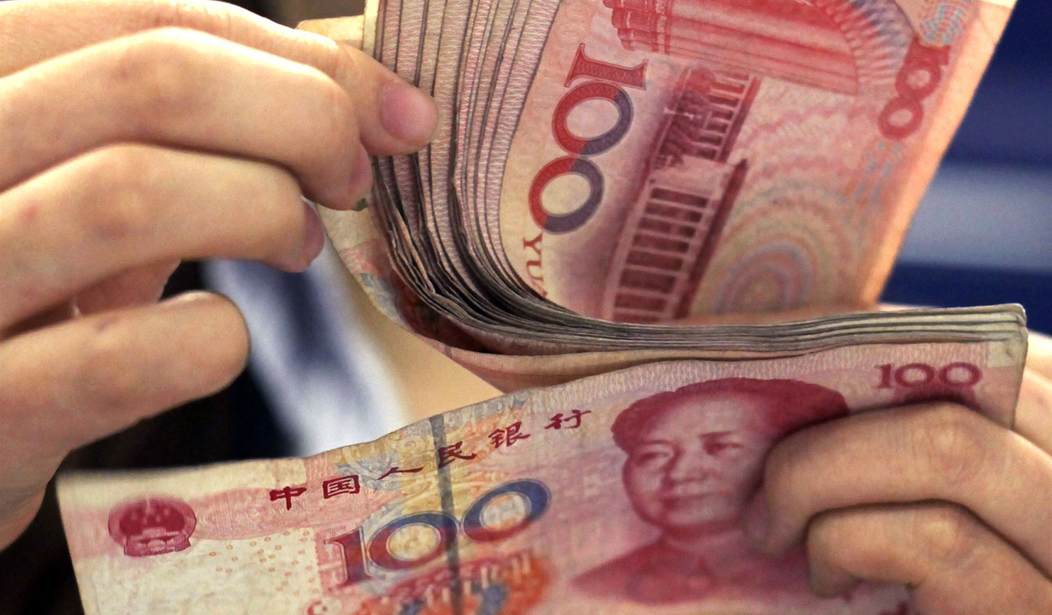
The Iranian closure of the Strait of Hormuz, with tolls extorted in Chinese yuan, poses a serious threat to the long-term viability of the petrodollar, which is why the current situation is absolutely untenable.
Related: Kenya Abandons U.S. Dollar, Petrodollar Decline Accelerates
China has stepped into the gap with aspirations of a rival “petroyuan” — up until now a pipe dream, but more viable than ever before with the current situation in the gulf.
Via Wikipedia (emphasis added):
Petroyuan is a form of the official Chinese currency, the yuan intended at least initially for oil trading. On 26 March 2018, the Chinese government issued the first long term oil trading contracts denominated in petroyuans. This project exists to attempt to compete with the U.S. petrodollar as a main currency in crude oil transactions, whose hegemony has led the market since the dollar standard was first established in 1971, replacing the gold standard and giving the United States the power to manage most of the world's currency supply (around ~60%).
Continuing via Fortune:
While the U.S. and Israeli militaries have severely degraded Iran’s capabilities, the regime still retains enough to combat power to selectively close off the Strait of Hormuz—unless countries negotiate safe passage and pay in Chinese yuan…
But even before the Iran war, the petrodollar regime had come under pressure, Deutsche Bank noted. U.S. sanctions on oil from Russia and Iran created an illicit trade that relied on other currencies, like the yuan.
Saudi Arabia also joined mBridge project, a central bank digital currency initiative led by China that takes on the dollar-payment infrastructure.
“The current conflict may expose further fault lines, by challenging the US security umbrella for Gulf infrastructure and the maritime security for global trade in oil,” analysts warned.
Recently, in order to prop up domestic currencies but also in possible forecasting of a long-term ebb of petrodollar supremacy, foreign central bank USD holdings hit their lowest levels since 2012.
Via Financial Times (emphasis added):
Foreign central banks have slashed their holdings of Treasuries at the New York Federal Reserve to the lowest level since 2012, as countries sell the US government bonds to prop up their economies and currencies in the wake of the Iran war.
The value of Treasuries held in custody at the New York Fed by official institutions — a group that is largely made up of central banks but also includes governments and international institutions — has dropped by $82bn since February 25 to $2.7tn, according to Fed data.
The decline in these holdings since the war began a month ago highlights how the surge in energy prices triggered by Iran’s closure of the Strait of Hormuz, a vital waterway, has upended the finances of countries that rely on oil imports, as well as boosting the dollar across the board.
All of which is to say: if the dollar is to maintain its status as the global reserve currency — which is essential to propping up the U.S. economy with tens of trillions of dollars in national debt — opening up the Strait has to be the absolute number one priority of the administration.