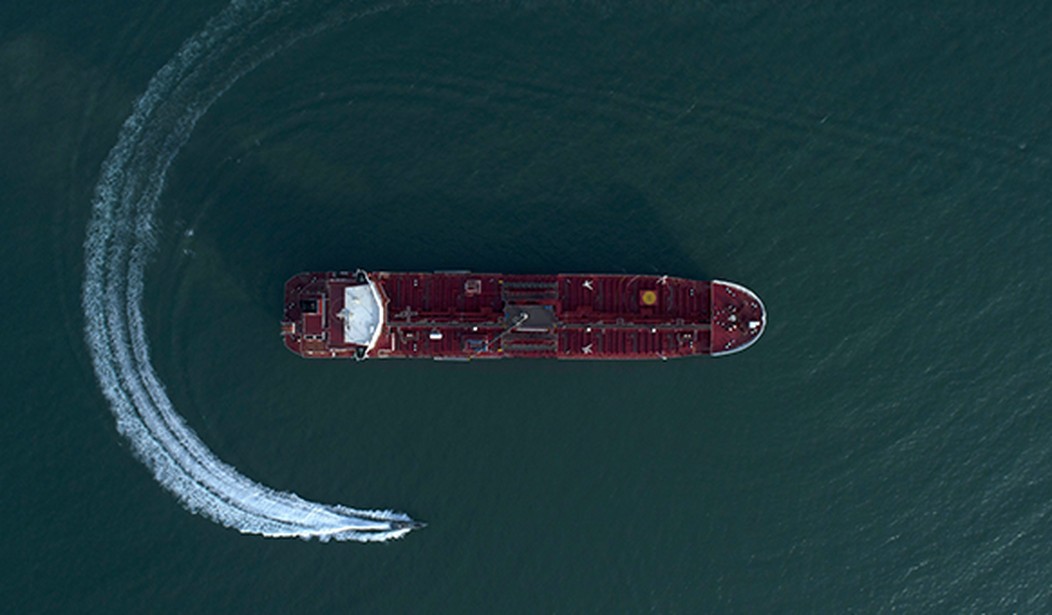
I must admit that I was feeling a little guilty about the side effects of President Donald Trump’s elective though sorely needed war on Iran. The dying regime there, clinging to its last shreds of power, has retaliated by shutting down maritime traffic in the Strait of Hormuz, and this has led to the loss of nearly a quarter of the world’s seaborne fuel trade. PJ Media’s Stephen Green wrote on Wednesday:
Before Epic Fury, something like 20% of the world's LNG and 25% of seaborne oil trade passed through the strait each year and accounted for something like 10-15% of Europe's energy supplies. Losing that hurts, and Politico reported on Tuesday that one "top Brussels official urges Europeans to work from home and drive less."
Read Stephen’s entire column: Europe Needs to Hear This Harsh Truth
The resulting supply crisis has, of course, led to shortages and price spikes throughout the world. And while we Americans will be fine — we were paying more for fuel just a few short years ago as COVID panic-eers and envirofascists in the Biden administration broadsided energy supplies, plus we produce more fuel than we need here at home — the world's less-prosperous nations are feeling the pinch. Some can ill-afford the price increases, even though they are an affordable and worthwhile investment for us.
So I was feeling a little contrite. But as I read through today’s crop of international headlines, I started chuckling, then laughing outright. The constipated traffic through the strait has exposed the failure of something that Western central planners could pretend was working until now: “green” energy generation.
Doomberg, an energy, finance, and geopolitics collective on Substack, focused on Australia in the intro to today's post:
The Land Down Under consumes roughly 1.1 million bpd of oil, but only meets about a third of that with domestic production. Worse still, Australia is no longer a major oil refiner, with nameplate capacity to produce fuels like gasoline, diesel, and jet fuel able to cover only a fifth of its needs. It’s not that the country can’t operate refineries; it simply chose to stop building them and allowed existing facilities to wither into obsolescence. Greenpeace Australia Pacific surely celebrated those decisions.
Iran’s closure of the Strait of Hormuz has laid bare the folly of Australia’s energy stance, and the country barrels towards shortages and catastrophe.
In Ireland, which banned the harvest of its native fossil fuel, peat, in 2021, "in response to EU directives on climate change," and sales of turf in 2022, the fuel crisis is also causing pain. Irish news site Gript reports:
Aontú’s Monaghan representative, Olivia Larkin, said that people are “badly struggling” in fuel price crisis sparked by the war and that it is “ludicrous” to think of people “freezing” while “we have turf in this country that could be sold”.
“This crisis is really biting and people are badly struggling . People are suffering from the sharp hike in costs for everything and while we may be in meteorological Spring it is cold, and the weather continues to be unsettled,” Ms Larkin said.
“I am acutely aware of elderly people, disabled people and those with young families who just cannot keep up with the huge increases,” she added. “Costs of everything are escalating on an almost daily basis, inflation is now running at 3.6% and this is shaping up to be the worst ever global energy crisis.”
“It is ludicrous to think that people are sitting freezing and afraid to turn on their heating while we have turf in this country that could be sold. This is a crisis and as we have seen from other crises, the Government can act very quickly when it wants to,” she said.
It's the same the world over, of course. Preening woke Western nations have now spent decades and trillions of dollars on the construction of so-called green energy infrastructure. Untold research, resources, education, and goodwill have gone along into the endeavor.
And it begs the question, Why don't you guys just turn up your super awesome windmill-solar-tidal-geothermal-unicorn fart green energy grids and solve the crisis?
Because the truth is that, if all of this effort and expense and goodwill haven't yet produced an alternative energy grid that can provide for the energy needs of modern civilization, it's never going to.
And it's never going to because it physically can't.
Date scientist Tony Seruga posted an essay titled "$2 Trillion Later, The Green Revolution Collapsed: How Chasing Weather Power Bankrupted the Grid and Cost the World $40 Trillion in Growth" on X. Here are some key excerpts (though you should read the whole thing):
Between 2010 and 2026, governments and corporations poured roughly $2 trillion into solar, wind, and “net‑zero” programs under the promise of an imminent clean‑energy transition. What the public received instead was an illusion—a fragile grid, higher electricity prices, and negligible climate benefits. Energy remained just as carbon‑intensive, but far more expensive and unreliable.
[…]
When measured by physical reality rather than marketing slogans, that $2 trillion bought roughly the energy output of $400 billion in conventional power. It displaced almost no fossil fuel consumption and arguably reinforced it, since idling backup plants waste fuel. Worse, dependence on Chinese supply chains for solar panels and rare‑earth minerals eroded national energy independence and inflated emissions through hidden mining and shipping costs.
If that same capital had been spent on modern nuclear or advanced natural‑gas infrastructure, the outcome would have been transformative. $2 trillion could have built about 285 GW of nuclear capacity (powering 250 million homes reliably for 70 years) or 1,650 GW of efficient gas plants (enough for 900 million homes for 30 years). Either path would have cut 70–80 gigatons of CO₂, reduced global electricity costs by half, and created genuine energy security.
Instead, the current “green” trajectory delivered rising utility bills, rolling blackouts, and greater reliance on geopolitical adversaries. Global power costs rose roughly 60%, contributing to deindustrialization in Europe, worldwide inflation, and a cumulative $37–40 trillion loss in global GDP—about half of one year of global economic output. That’s the price of mistaking ideology for engineering.
"The world might be in the early stages of what will become the most significant energy shock in modern times, but that hasn’t stopped policy advocates from aggressively pre-positioning for what comes after the crisis abates," Doomberg observes. "Will the coming shortages be the death knell of the hydrocarbon era and herald an acceleration of the so-called green energy transition? Or will the disastrous consequences of flouting basic physics finally convince the pro-renewables crowd that it’s time for a serious rethink?"
Sensible nations will choose the latter.
"The lesson could not be clearer: physics determines prosperity," Seruga concludes in his essay. "Dense, dispatchable energy such as nuclear or gas remains the backbone of civilization, and no amount of subsidies or messaging can legislate thermodynamics. The so‑called green transition did not decarbonize the planet—it impoverished it. The road to sustainability is not paved with solar subsidies but with unapologetic engineering and scientific honesty."
It's never going to get better for green energy than it already has, and this is all they've got to show for it. Energy security is national security, and when the chips are down, green grids cannot deliver what's needed.
Sometimes, a good old-fashioned geopolitical crisis is just the kick in the backside that is needed to get folks grounded back in reality. It's time for the woke West to get back to real energy that really delivers, and to take it seriously.
Also for our VIPs: Sorry, I Just Can't Panic About Iran Hurting the Global Oil Supply