
In an appeal I recently wrote to Michigan’s Jewish voters who are undecided about Democratic Senate nominee Abdul El-Sayed, I argued that they should recognize who the true friend of Jews and Israel is in the race: Republican Mike Rogers.
The case is not hard to make.
Rogers says Israel is America’s best ally in the Middle East, while El-Sayed won’t say whether Iran is a bigger national threat than Israel. Rogers recognizes that antisemitism is rising and getting more dangerous, while El-Sayed’s response to the March terrorist attack on Temple Israel was to say that “hurt people hurt people.” Rogers is running a campaign focused on an economic message of bringing industrial jobs back to Michigan, while El-Sayed seems to blame everything on the Jews and Israel, including the cost of eggs. Rogers says that Israel has “Western values baked into their political system,” while El-Sayed doesn’t believe that Israel should exist as a Jewish state. Rogers is a proud military veteran, while El-Sayed criticized American foreign policy when challenged by an Iranian-American University of Michigan student to condemn Iran’s Islamic Revolutionary Guard Corps.
That list doesn't even include El-Sayed's alleged Muslim Brotherhood ties, but it should be more than enough to show any voter opposed to antisemitism and hatred of Israel the right Senate candidate to back in Michigan. Still, I'd be surprised to learn that my article changed even one Jewish voter's mind, as I know how hard it is for so many Jews to leave the Democratic Party.
Related: A Final Appeal to Michigan’s Jewish Voters on the Fence About El-Sayed
But no one can predict what message might finally open someone's eyes to a truth that only seems obvious in retrospect. Dennis Prager has explained that it was one line from President Ronald Reagan — "Government is not the solution to our problem. Government is the problem." — that caused him to leave the Democratic Party for good in 1988.
President Donald Trump's method of persuasion is different from Reagan's. “Any Jewish person that supports [El-Sayed] should be ashamed of themselves,” Trump said at a campaign rally in Port Huron on Sunday. “You should never speak to them again.” I don't know any Jews in Michigan, so that's not a dilemma for me, but I do know a lot of Jews in California, many of whom will surely not be voting for the candidate in the governor's race who has stressed the importance of ensuring the safety of Jews in the state. I'll speak to them nonetheless, and surely some of those conversations will be aimed at trying to convince them that Steve Hilton and Donald Trump are true friends of the Jews and Israel.
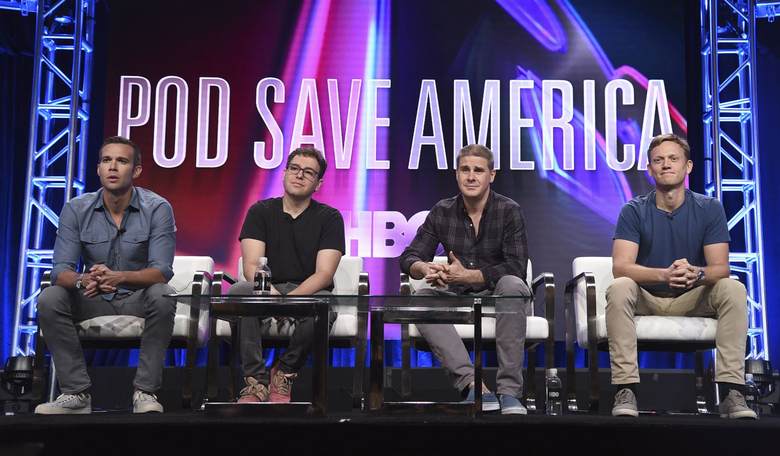
Many Jews are doing the exact opposite. Former White House speechwriter for President Barack Obama and current Pod Save America co-host Jon Lovett made his own plea to Jewish voters after Trump's rally in Michigan. On Tuesday's episode of the podcast, he said that "Jews in Michigan have a moral obligation to support Abdul ... to protect themselves from antisemitism and rising hatred in America." His argument was heavy on the anti-Trump and light on the pro-El-Sayed:
For Jews in America, our safety is based around the idea that there's a society in which we can have arguments and disagreements, but we respect those differences. Trump does not believe in that. And we need to have a check on Donald Trump in a Democratic Senate. And maybe Abdul is not your cup of tea. Maybe Abdul is not — is going to be a reliable vote against Israel. Fine, we can handle that. But we cannot handle a continued slide to this hateful authoritarian right. It will be dangerous for us.
This comes from a guy who supported Zohran Mamdani for mayor in New York City, yet ignores how much less safe Jews have felt in the city since he came to power. My PJ Media colleague Matt Margolis explained why so many Orthodox Jews are leaving New York City for Florida in the Mamdani era:
The numbers back them up. NYPD data shows hate crimes in New York City are up nearly 16% from last year, and half of them targeted Jews. Half. In a city with the largest Jewish population in the country, that should set off alarms at every level of government.
Mamdani's answer arrived last month as a $30 million strategy, complete with a shiny new Interagency Task Force to Combat Antisemitism. Critics quickly mocked it as a ruse, and it's easy to see why. The plan never defines antisemitism. It never explains what sets Jew-hatred apart from any other racial or religious bigotry. It never uses the word "Zionism," and it gives Israel a single passing mention. It even funds anti-Israel groups. On top of that, Mamdani declined to formally recognize Israel's existence while unveiling it.
In an appearance on Fox News, Ben Shapiro compared Lovett’s declaration that Jews must vote for El-Sayed to the claim that “you must vote for O.J. Simpson to stop spousal abuse.” El-Sayed, of course, claims that his opposition to Israel is not antisemitism. Jews on the left like Lovett will clearly point to statements from El-Sayed such as “I love Judaism and I love the Jewish people” to convince themselves that it’s fine to vote for him. (It should be remembered that O.J. wrote about Nicole, "If we had a problem, it's because I loved her so much.") To that argument, it needs to be said that anti-Zionism is just the new antisemitism, as the late Rabbi Jonathan Sacks often pointed out. (This video is one of the best proofs of that claim that I’ve seen.)
Even the writer Jonathan Chait, who calls himself a liberal, acknowledged that El-Sayed “would become the most fervently anti-Zionist senator” were he to win in November. But Chait, a Jew like Lovett, also wrote on X, “Jason Turkish is calling El-Sayed an anti-Semite. I don’t think he is. I do think he’s unwilling to take on anti-Semites because they’re part of his base. Whether that is sufficient reason to oppose him is a different (and hard) question.”
Clearly, proving that El-Sayed is a dyed-in-the-wool anti-Zionist is not enough to persuade many Jews to oppose him. As I was wrapping up this essay, I felt once again that it was unlikely to change any minds, even if any Michigan Jews planning to vote for El-Sayed were to read it. I found myself wondering whether there might be a line, like the Reagan line that sparked Prager’s political awakening, that could actually get through.
So I pulled down from my bookshelf Dennis Prager and Joseph Telushkin’s Why the Jews? The Reason for Antisemitism and turned to the chapter on anti-Zionism. Perhaps this passage could change the minds of even Jon Lovett, especially if he keeps in mind that Trump is the president who finally took action against Iran to prevent another Holocaust of the Jews and that there are more than twice as many Jews in Israel now as when Why the Jews? was published in 1983.
Whether the destruction of the Jewish national movement and the Jewish state, a holocaust of the three million Jews of Israel, and the subsequent abandonment of world Jewry to the goodwill of the world with no refuge of its own are carried out in the name of anti-Zionism or antisemitism is quite irrelevant to Jews. That the people who want to do these things now call themselves anti-Zionists instead of antisemites is an interesting historical fact. There may be some differences in what aspects of Jewish life anti-Zionists and antisemites hate. But these differences are of interest only to historians. For Jews the consequences are identical.
The only moral obligation Jews in Michigan have is to take that warning seriously.