


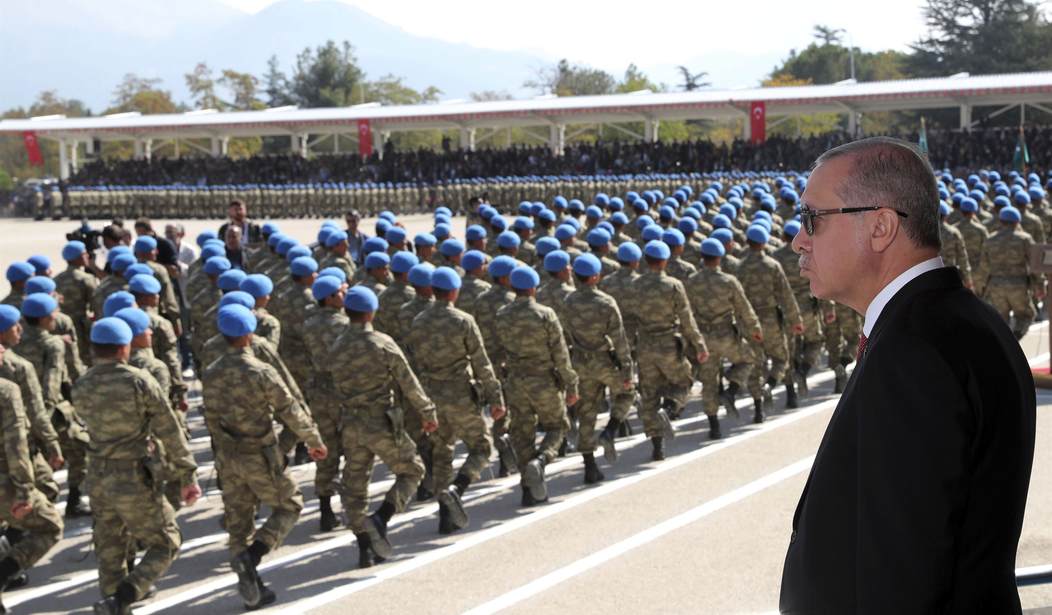
The West is slowly recognizing Qatar's role in what has been described as a Muslim Brotherhood axis that aims to win a civilizational war throughout the United States, Australia, Canada, and Europe. Whether through funding universities, investing in real estate, or owning football teams, the Qatari regime is a major strategic and financial force behind this effort. But Western nations seem less aware of the country seeking to provide the boots on the ground to advance this Islamist agenda.
Israel, however, hasn't overlooked the grave threat this country — Turkey — represents.
On August 18, the Israeli Air Force struck Syria’s Idlib province, hitting the Abu al-Duhur air base and damaging its runway and storage facilities. Israeli intelligence indicated that Syria was preparing to allow Turkish troops to deploy there, while Israeli reporting also cited plans to install Turkish air-defense systems.
Itay Medina, head of the Security Policy Institute at the Israel Defense and Security Forum, says that Turkey wants to use the Syrian regime to expand its power and influence throughout the region while Salafi-jihadist movements like ISIS and al-Qaeda are weak. Medina calls NATO member Turkey a serious threat because it is not open about its ambition to create a “new Ottoman Islamic empire” that dominates the region. I wrote more than two decades ago that Middle East scholar Daniel Pipes viewed Turkish Prime Minister Recep Tayyip Erdoğan as a greater threat to the world than Osama bin Laden. With bin Laden now dead, that claim looks even stronger today.
Related: Opening the Strait of Hormuz
Medina explains the obvious threat to Israel: Syria borders Israel, and a Turkish military foothold in Idlib could enable Turkey to expand its influence and military presence southward toward the Golan Heights. But he says Israel's strikes in Syria don't just benefit Israel:
It’s good, and everybody should realize that it’s an attack that [is], again, like always, good for Israel. And everybody [sees] that as an Israeli strike for Israeli targets, for Israeli aims. Yes, [that is the] truth, but it’s [also] good for the region because nobody really wants, after ISIS and after Iran, [to] get another radical Islamic empire ruling the region and [having] this bad and negative influence in the region and outside of the region. And we saw—and everybody, I think, already realized—that radicalism and instability in the Middle East, like it was [with] al-Qaeda and then Zarqawi and then ISIS, or [as] it moved from them to Iran, [bring] problems not only to Israel, not only to the region, but to the rest of the world—energy-wise, [economically], military-wise, and even [through] some strategic threats coming from nuclear or conventional [weapons].Medina is not saying that the battle against Iranian forces and the Shiite axis, which he views as the most important and immediate threat, is over. He thinks the U.S. and Israel need to achieve a decisive victory against Iran but sees Turkey as perhaps the number one threat on the horizon.
Maintaining Israeli air superiority over Syria, Medina stresses, is urgent with the war against Iran still ongoing and the possibility of further Israeli airstrikes. He also warns that Israel can't allow Syria under Ahmed al-Sharaa to become a proxy for Turkey the way Iran turned Hezbollah Lebanon into its proxy.
In another warning, Medina recalls what he describes as the Obama administration’s failed strategy of relying indirectly on Iranian forces as “the boots on the ground against ISIS.” He says using Turkey and Qatar as a counter to a weakened ISIS and Iran would be unwise, to say the least.
I insist ... [that cooperating] with the Turks and the Qataris as the next, let’s say, influencer—the next active ... power in the region—would be a mistake. In less than a decade, everybody would understand that. I mean, everybody would say, "Who were those [people] who, in 2026, didn’t see this coming?" ... [We] will meet Turkey and Qatar in many hubs ... in the Western states [and] in the Middle East as a military, Islamic radical power, together with a lot of influence in the media and ... a lot of money, [and] say, "What can we do with them?" So I suggest [seeing] this attack—[the] Israeli airstrike [on] this little ... military ... airport, Abu al-Duhur—not only as a tactical attack but as ... an attack that [symbolizes] all [of] what [I am saying] and [seeks] to prevent all [of] what [I am warning about].To those in the West who say the threat of a Muslim Brotherhood axis comprising Turkey and Qatar is exaggerated, Medina points out they have the same goal as Iran: a war of Islamic civilization against the "infidels."
The only thing that is different is how they are doing that. The most radical [groups] were al-Qaeda and ISIS because they decided, "It’s going to be, now you’re going to see us. We are going to kill everybody we can. We go [directly] to hit the Americans [with] 9/11, and [we] go [directly] to hit the West in their own homelands, and we are going to strike everybody everywhere."
The Iranians did it in [a] much clever[er] way. So, okay, we’ll gain power. We’ll gain those proxies all over the Middle East. [We] will give them some military capabilities, like drones, and then from drones to missiles to rockets, and then from rockets to accurate missiles, and then huge numbers, and then Iran itself, and above all, the nuclear umbrella. This is a much more, let’s say, threatening and much more strategic point of view [for] doing that.
And the third one is this axis of [the] Muslim Brotherhood, led by Qatar and Turkey. Now, Qatar is the money and the brain. Beyond [that], [the] Turkish army and capabilities are boots on the ground. And let's see where there are boots on the ground: They began in Libya, in Somalia, [and are] now in Syria. They're trying to do it in Gaza. They're doing [it] in [the] north of Iraq, [gaining] more and more influence and trying to do that through the combat, let's say, against the Kurdish people or Kurdish parties. But in a way... [that allows them] to have influence in Iraq and Syria as well. And, of course, they're trying to do so through those Islamic elements, through the refugee — refugee leverage or whatever — in Western Europe. And they are a part of Europe.Doesn’t it make sense to deal with Turkey now, while the threat remains limited, rather than wait until it expands its military capabilities across the region, as Iran did?
Editor’s Note: Thanks to President Trump and his administration’s bold leadership, we are once again respected on the world stage, and our enemies are being put on notice.
Help us continue to report on the administration’s peace through strength foreign policy and its successes. Join PJ Media VIP and use promo code FIGHT to receive 60% off your membership.





Join the conversation as a VIP Member